
Paolo Maldini, one of the most decorated defenders the game has produced, put his entire defensive philosophy in one sentence: "If I have to make a tackle, I have already made a mistake." A tackle is a defender admitting he guessed wrong, or guessed too late. This game is built to put a defender in exactly that position on purpose — not through pace or skill, but through a pass he's forced to help create himself, and then can't see coming.
The Game: A Line of Three, Broken by a Pass Nobody Can Read
Setup
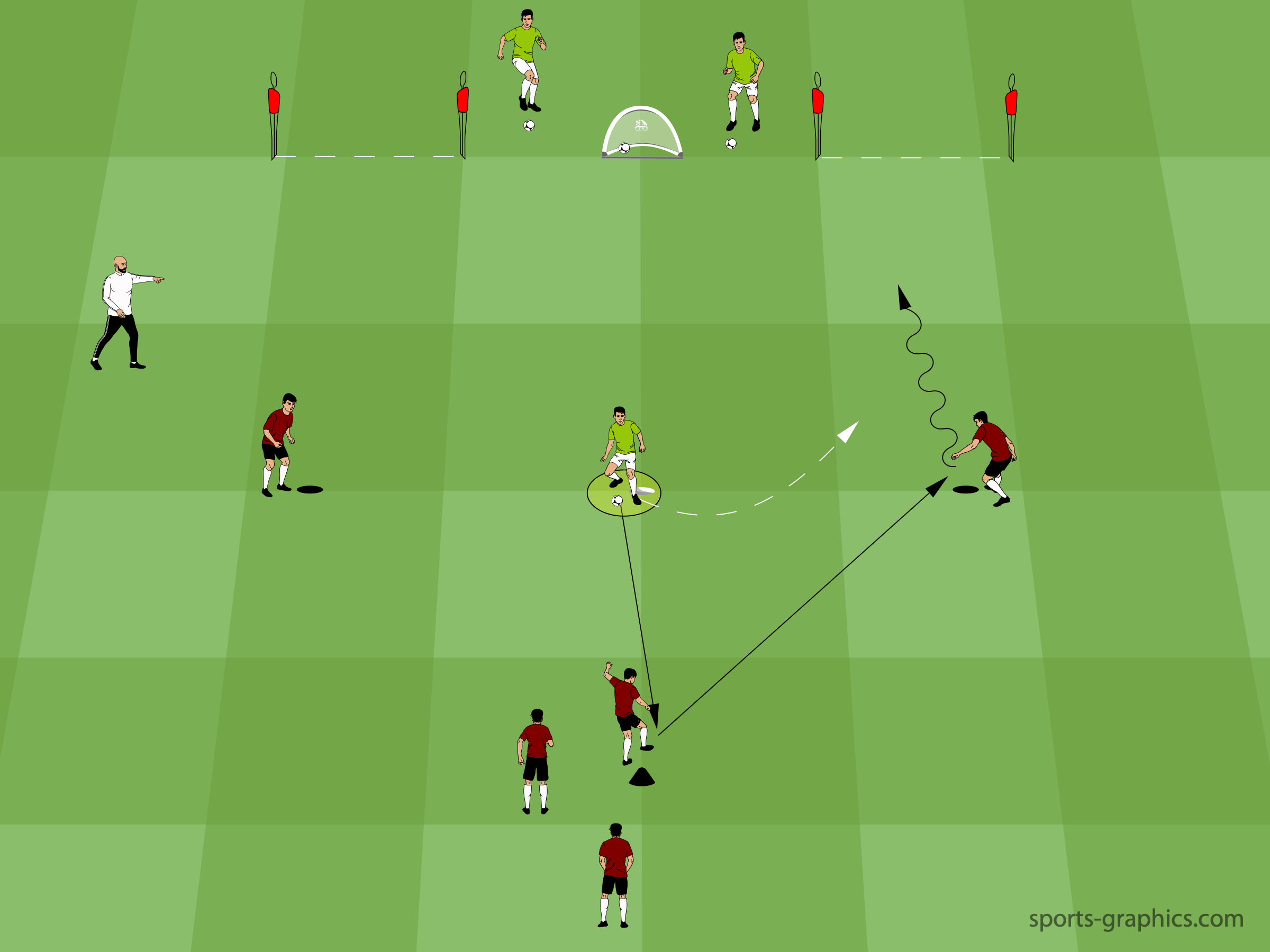
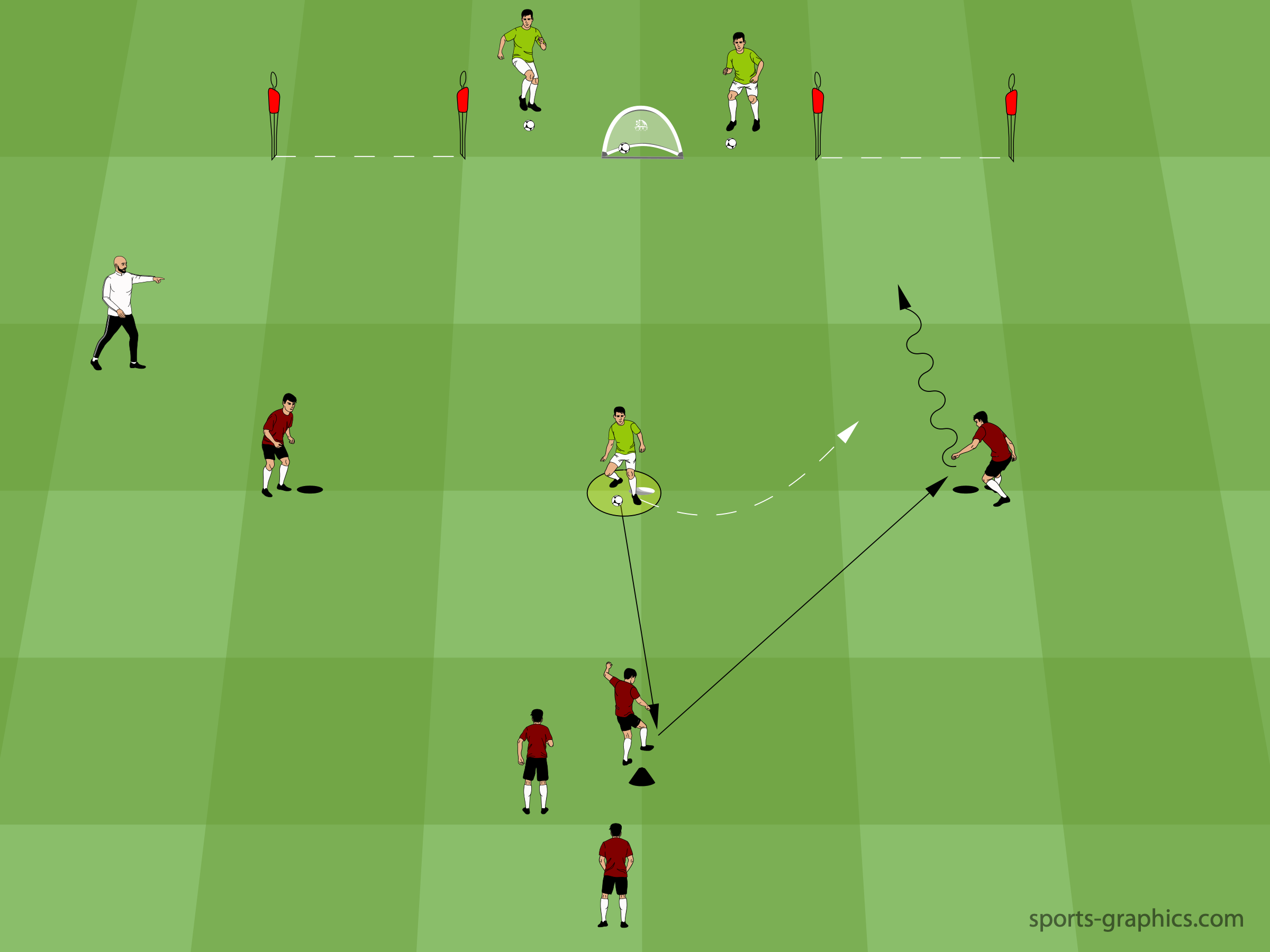
You need four players and two targets. Three attackers: a server (A) facing the play, and two wide options (B and C) spaced evenly on either side of the defender, all three standing on the same line — B, D, and C — that the attack has to break through. The defender (D) stands in the middle of that line, between B and C. Beyond the line, place a dribble gate along the sideline on each flank, roughly level with where B and C are standing, and a single mini-goal centrally behind D.
How it plays
A starts with the ball and plays it straight into D. By the rule of the game, D has to return it immediately, first-time, back to A — no dribbling out, no holding it. The instant the ball is back with A, A has to find either B or C, also first-time. No delay, no second touch to set it up.
The rule that creates the advantage
That forced return pass is doing more work than it looks like. Making D play the ball back on his first touch means he can't use that moment to set his feet, check his shoulders, or shift his weight toward either wide option — he's still recovering from his own pass when A immediately releases the next one. A can use exactly that half-second to disguise where the ball is actually going: body shape open to one side, ball played to the other, no backswing tell. D has to guess which of B or C is about to get the ball, and if he guesses wrong — or doesn't commit at all — whoever receives it is now in a clean 1v1 against him.
From there, the receiving player has two ways to finish the move. Beat D wide and dribble through the gate on the sideline to break the line down the flank. Or, if D recovers well enough to cut off that lane, come back inside and finish on the central mini-goal instead.
What to coach
For the passer, the disguise is the entire point of the exercise — coach the eyes and the shoulders, not just the pass. A player who stares at their intended target before playing it is giving the defender a free read; the best version of this pass looks identical right up until it isn't. For the defender, resist the instinct to fully commit toward either side the moment the return pass leaves his foot. The players who defend this well stay central and balanced for as long as possible, reading the passer's body rather than reacting to the ball itself — which is a different skill than recovery speed, and the one this game is actually testing. For the receiving attacker, the first touch decides everything: a heavy touch wide kills the dribble-gate option before it starts, so the first touch has to be played across D and into space, not just controlled.
Why the Defender's Dilemma Is the Real Coaching Point
It's tempting to treat this as a finishing or dribbling game, because that's where it ends. But the moment that actually decides the outcome happens earlier — in the half-second after D's return pass, when he either reads A's disguise correctly or doesn't. That's a perception problem before it's anything else, and it's worth coaching it as one: ask a defender who guessed wrong what they were looking at in that moment, rather than just telling them to recover faster next time. The wide 1v1 that follows is where game-realistic pressure takes over — but by then, the defender has usually already won or lost the point that mattered most.
This is also a good example of why a small overload like this beats an isolated passing pattern for teaching a player to break a line: there's a real defender to read, a real decision to disguise, and a real 1v1 to win or lose — nothing about it can be run on autopilot.
Try This the Next Time You Want a Defender to Anticipate, Not React
Most 1v1 games start with the defender already set and facing his opponent. This one starts with the defender still recovering from his own pass — which is exactly the moment real defending actually happens.
If this changes how you set up a 1v1 breakout in your own sessions, share it with a coach who's still building 1v1s that let the defender start ready.