
Most teams don't lose the ball trying to play out from the back because their center backs can't pass. They lose it because the presser reaches the ball before the picture in their head catches up. The fix isn't better technique — it's a rehearsed sense of exactly how much time a delayed press actually buys you.
This 2v1-into-2v2 progression isolates that exact moment, then scales it into a full buildup phase.
Setup
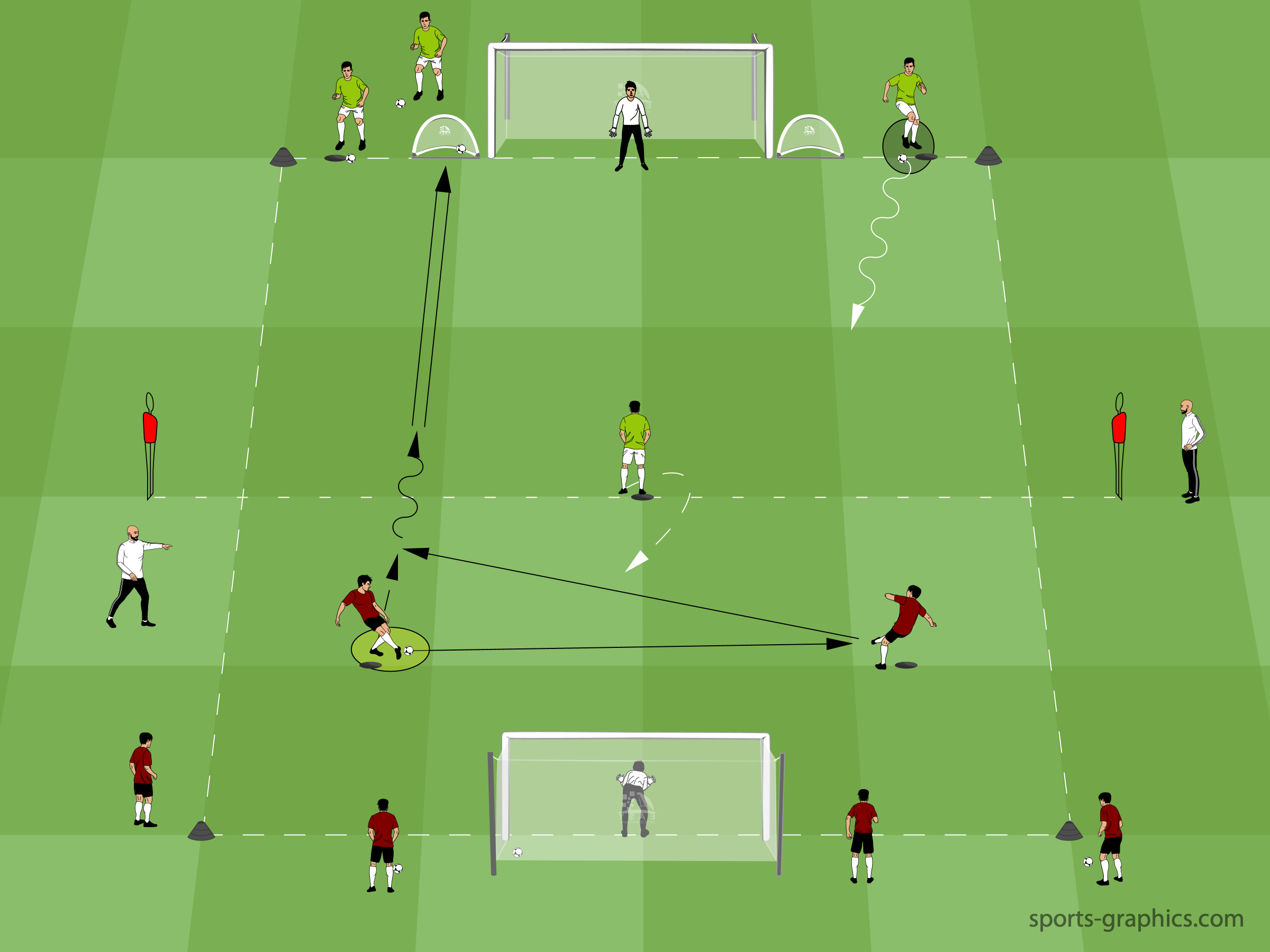
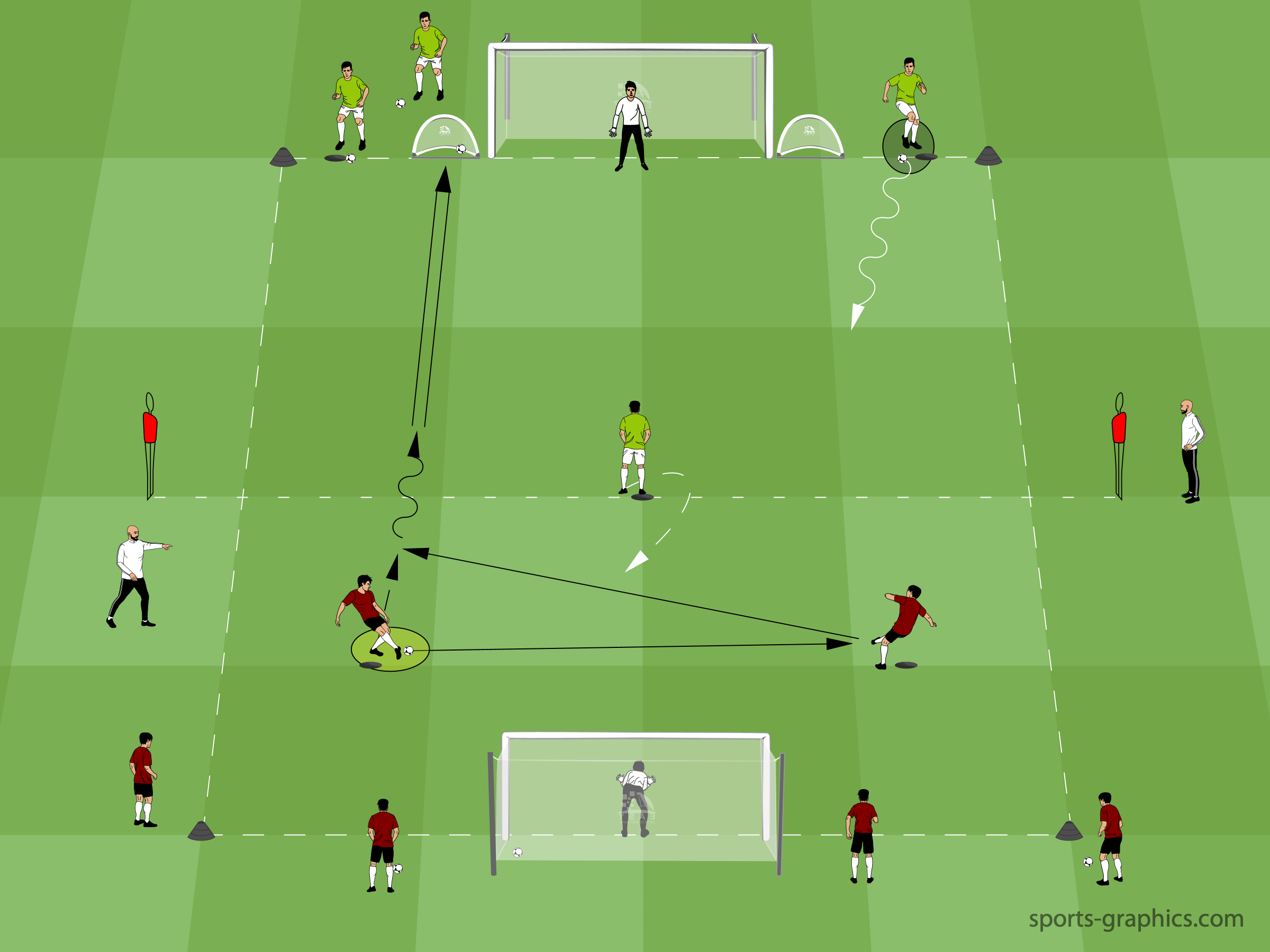
Mark a 25x30m field with two full-size goals. Place two mini goals directly next to one goal. Use the halfway line as the offside line for phase two, and set floor markers for each player's starting position.
How It Plays
Phase one starts with a striker turning their back to the two center backs. The center backs combine and attack 2v1 — no offside — with the striker acting as the lone presser. Target is either the full-size goal or the mini goals.
Once that sequence resolves, a second attacker joins from the baseline and the picture becomes a 2v2, now played with offside.
The Delayed Press
The whole exercise runs on one deliberately built-in detail: the presser starts facing the wrong direction. That head start is what makes the buildup easier and the press genuinely harder — not a rule, but a spatial trigger that recreates a real moment teams face constantly against a well-organized front line.
It also quietly does a second job. Because there's no offside in phase one, the center back who doesn't receive the first pass has to decide on their own whether to push up into the second phase — the transition moment itself teaches positioning, rather than a coach's instruction doing it for them.
What to Coach
Watch for how quickly the center backs recognize the pressing angle closing — the advantage from the presser's bad start position doesn't last, and good buildup play here means playing forward before it disappears, not after. For the non-receiving center back, the coaching point is the decision to advance into the second phase: too early and they're caught out of position if possession is lost; too late and the buildup stalls with no passing option ahead.
Raise the difficulty by moving the mini goals deeper to simulate a longer pass into midfield, or by running a 3v2 instead of a 2v2 in the second phase.
Individualizing by Position
Center backs are the buildup players here — the ones learning to beat a team's first line of pressure through combination play, not just individual passing range. The presser is played by a striker, learning to angle their run so the center backs' first pass is genuinely difficult, not just present.
Pep Guardiola has pointed to exactly this trade-off in his own coaching philosophy: "when you play out with quality then the rest of play comes fluidly." The center backs in this drill are learning precisely that — that clean buildup under a delayed press isn't a lucky escape, it's a repeatable habit.
This pairs naturally with a team that's already comfortable defending high — the two sides of the same coin are pressing well and building out against it, and a squad that's drilled both understands the moment from either shirt.