
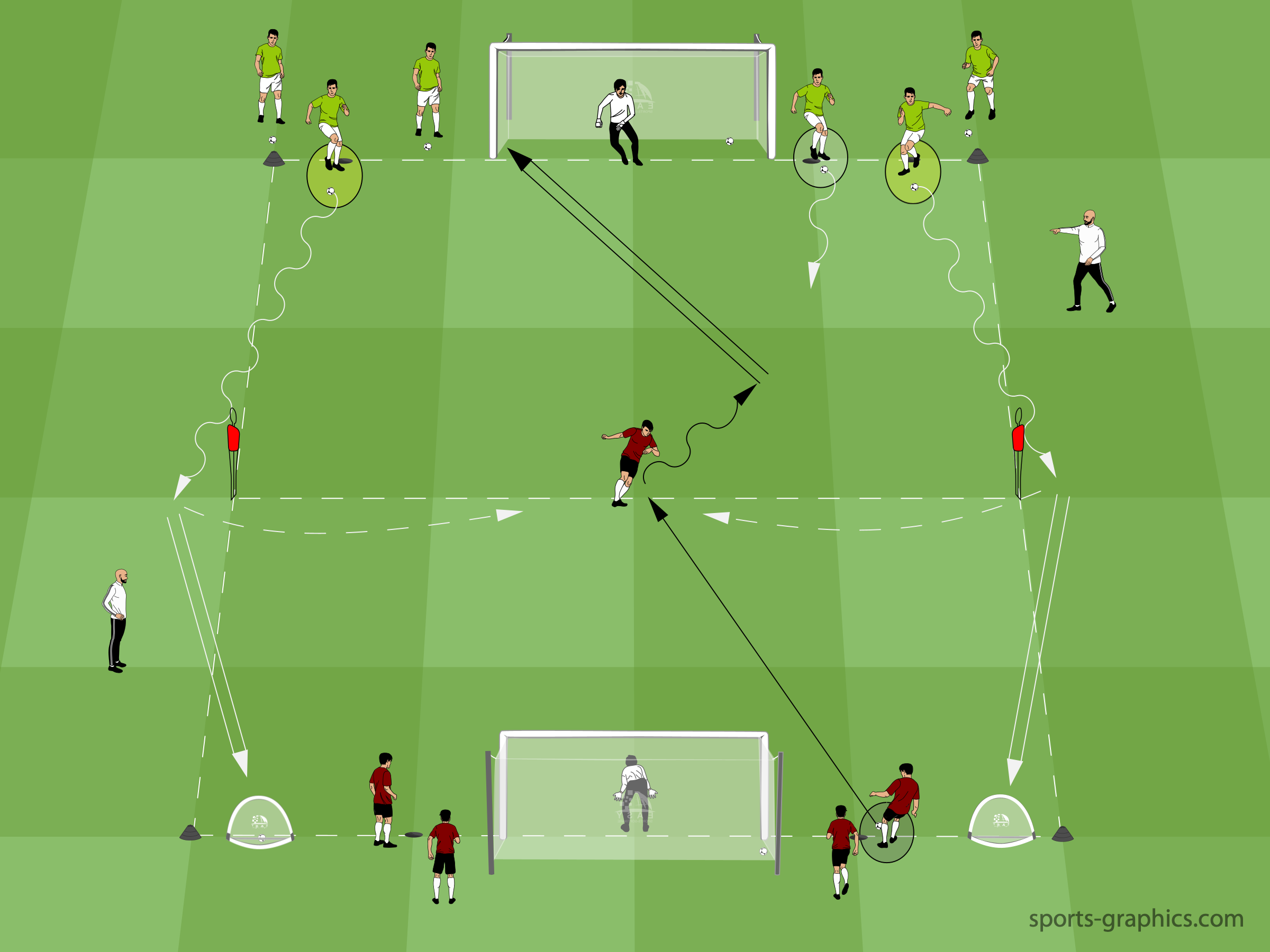
There's a common assumption in coaching that a game-realistic moment has to be trained in the actual part of the pitch where it happens in a match — a fullback's typical actions get trained out by the touchline, because that's literally where a fullback lives during a game. It's not wrong, exactly, but it's not the only way to get a real repetition either. As Johan Cruyff put it, "Playing football is very simple, but playing simple football is the hardest thing there is." Realism was never really about standing in the exact spot on the grass where the moment usually occurs.
It's Not About the Location — It's About the Trigger
Tie a position's training too tightly to its usual real-estate, and you lose flexibility without actually gaining much. What makes a moment game-realistic isn't the patch of grass it's happening on, it's whether the trigger that creates the moment is still intact — specifically, pressure arriving from the direction it would arrive from in the real situation. A fullback reading pressure that's showing them down the line doesn't need to be standing on the actual touchline to read it; they need pressure arriving from the actual direction that situation creates. Get the direction of the trigger right, and the location becomes flexible. Get it wrong, and setting the activity up in the "correct" real-world zone doesn't save it.
The Setup: Two Goals Facing Each Other
That's exactly what clever rules and a setup built around two goals facing one another make possible. Instead of needing the real touchline corridor to recreate a specific directional trigger, the two-goal setup can manufacture that same pressure — from the same direction, at the same kind of moment — without needing the actual zone of the pitch where it would normally happen. That flexibility comes with a bonus, not a cost: two real goals to attack means more shooting opportunities, noticeably higher player interest than a mini-goal or a cone gate, and the intensity that follows from both. You're not trading realism for convenience here — you're keeping the part of realism that actually matters and picking up extra engagement along the way.
Game 1: The Turning Press Window
Setup
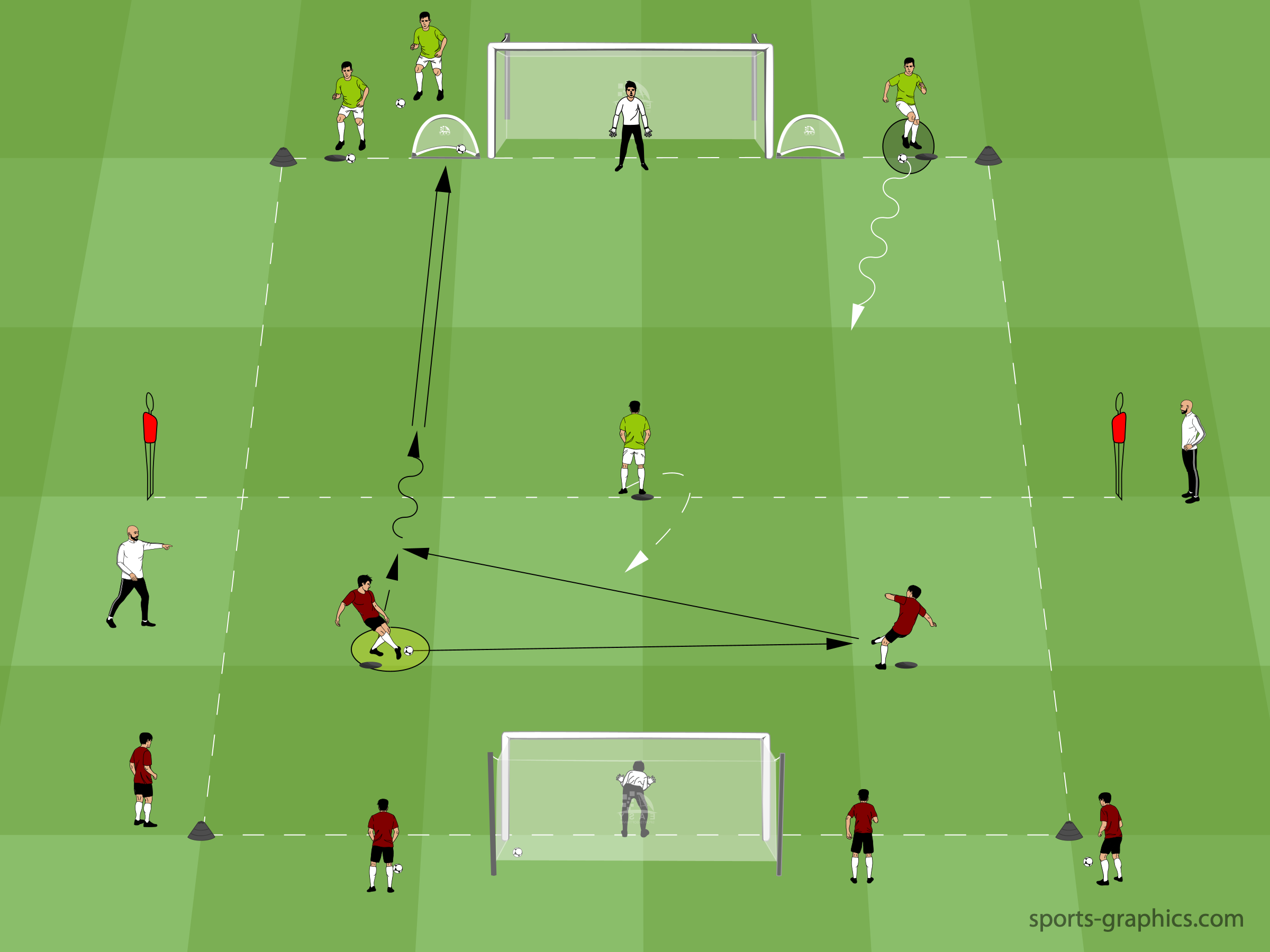
You need two center-backs, a goalkeeper, and a striker who starts with their back to the center-backs — screening the pass instead of pressing it yet. Set up a main goal with the keeper, plus two mini goals nearby as extra targets; the keeper is allowed to cover all three. You'll also need a second striker (and, for the variation, a third) ready to join later with a fresh ball.
How it plays
While the striker stands with their back turned, the two center-backs simply pass the ball between themselves. On the coach's whistle, the picture changes: the striker turns and presses, and it's now a 2v1 in the center-backs' favor. Because the striker has to turn before they can actually close anyone down, real pressure arrives a half-beat late. That's the window — one center-back uses it to push their position higher, receive, and go straight at goal, choosing between the keeper's goal or either mini goal. The instant that action resolves, the second striker enters the field with a new ball and turns the picture into a 2v2 attacking the opposite goal, offside enforced at the halfway line — so the center-backs have to snap into defending a real transition immediately, with no reset in between. Add a third striker for a 3v2 if you want the recovering side to have even less margin for error.
What to coach
The whole drill hinges on that half-beat window the turning press creates — the center-back shouldn't push higher before it opens, and shouldn't hesitate once it does. Coach the touch that gets them half a yard clear of the recovering striker rather than just receiving side-on and hoping. With the keeper covering three targets, the decision on which goal to attack should be quick and based on where the keeper actually is, not a coin flip. And once that first action ends, the standard counter-defending principles take over for the 2v2 or 3v2 the other way: get goal-side immediately, delay rather than dive in, and communicate who's taking which attacker. The trigger that matters here isn't a direction of pressure like a fullback out wide — it's timing. Recognizing exactly when a delayed press actually arrives is its own version of the same idea: the real skill isn't tied to one specific patch of grass, it's tied to reading the cue correctly.
Game 2: The Finish-Then-Turn Wave
Setup
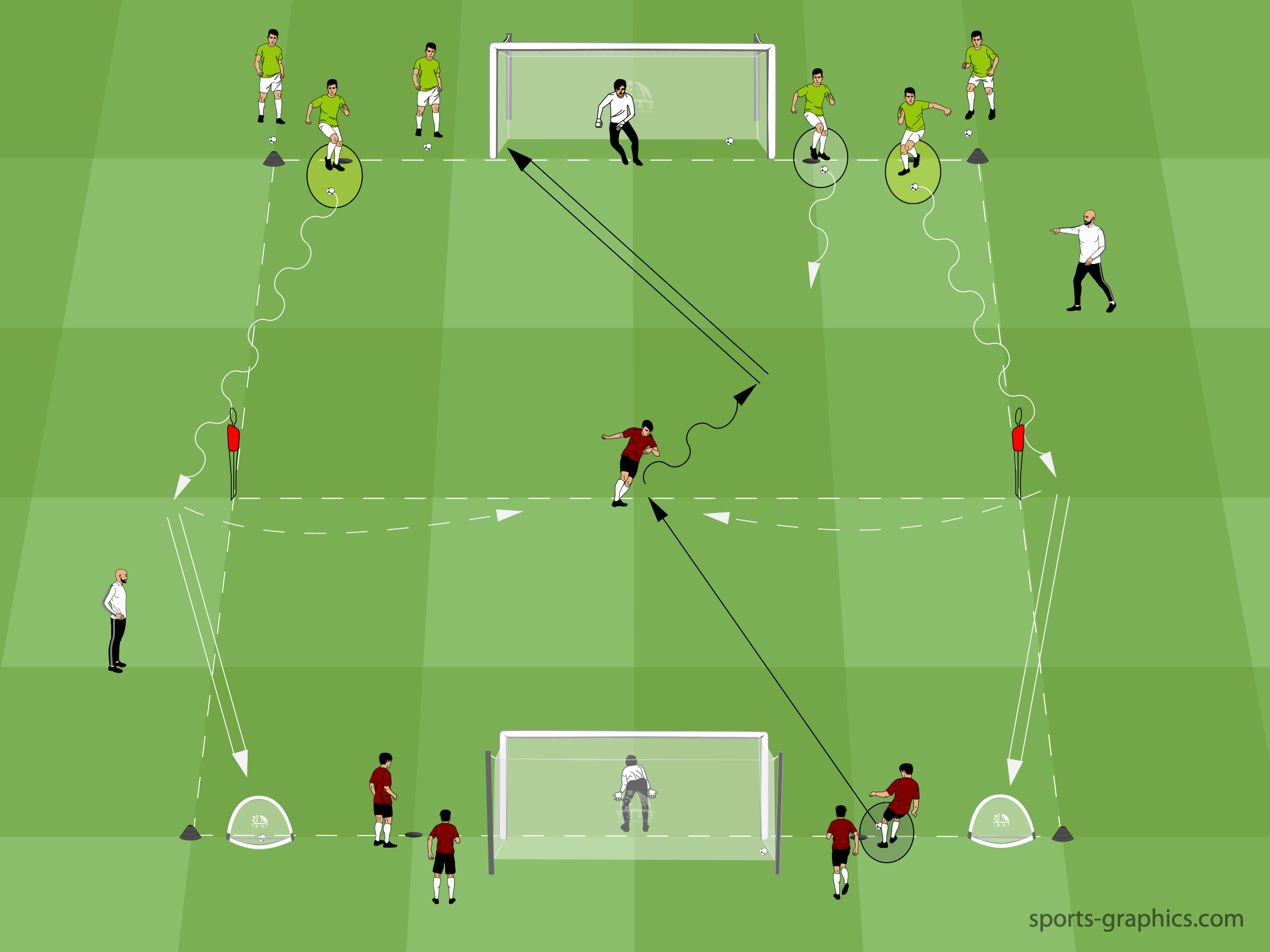
Set up two mini goals around a couple of dummies, with two attackers ready to start on the coach's whistle and a third player — a central midfielder — waiting on the halfway line.
How it plays
On the whistle, the two attackers sprint at full tempo to finish past the dummies into either mini goal. The moment both have taken their shot, the central player is played into the game and has to turn against the two nearest defenders — who are now closing in fast — before finishing themselves. The emphasis is entirely on turning fast and clean under real pressure, not on the finish itself. The variation sharpens that further: only the attacker(s) who actually scored on their mini goal are allowed to join the press against the central player. Miss your finish, and you don't get to defend — which means the central player might be turning against one defender, two, or, on a good day for the attackers, none at all, and the space changes every rep depending on how the first phase went. Whatever the central player does next — beats them and finishes, or gets closed down — immediately kicks off a new wave: a 3v2 or 2v2 (again, depending on how many defenders qualified), which keeps the whole picture live and demands an instant re-press from whichever side just gave the ball up.
What to coach
Turning speed and cleanliness under real closing pressure is the entire point of this drill — a good decision that arrives a half-second too slow is still a lost duel. Use the variation deliberately: fewer defenders makes the turn easier and rewards a positive first touch, more defenders forces a tighter, more disguised turn, and you can dial the difficulty up or down just by how strict you are about who "earned" the right to press. The rolling wave at the end is doing its own separate job — because the picture never resets cleanly, players have to find the instinct to counter-press again immediately rather than treating each phase as finished. If your team already works on that instinct directly, our deep dive on scaling a pressing trigger from a single duel up to a full game covers the same idea from a different angle.
One Format, Every Age Group
Because both activities are built around preserving the trigger rather than around age-specific complexity, the games themselves don't need to change much between a U10 session and a professional one — the coaching around them does. With younger players, the job is mostly to explain the setup and the rules clearly and then get out of the way: let them find their own solutions through repetition, without over-explaining the "why." With older and more advanced players, you can push much further into detail — naming the exact body shape, timing, or angle that made a moment work, and explicitly tying it back to what the equivalent situation looks like in an 11v11 game, wherever on the pitch it actually happens. Same activity, same underlying trigger, just a different depth of coaching language depending on who's in front of you.
Try This the Next Time the Real Zone Isn't Available
Next time you want to train a position-specific moment but don't have the real part of the pitch free to do it, resist the instinct to wait for the "right" space. Check the trigger instead — if the pressure is arriving from the direction it actually would in a match, the location was never the part that mattered.
If this changes how you think about where you train position-specific moments, share it with a coach who still thinks a fullback drill has to happen on the touchline.