
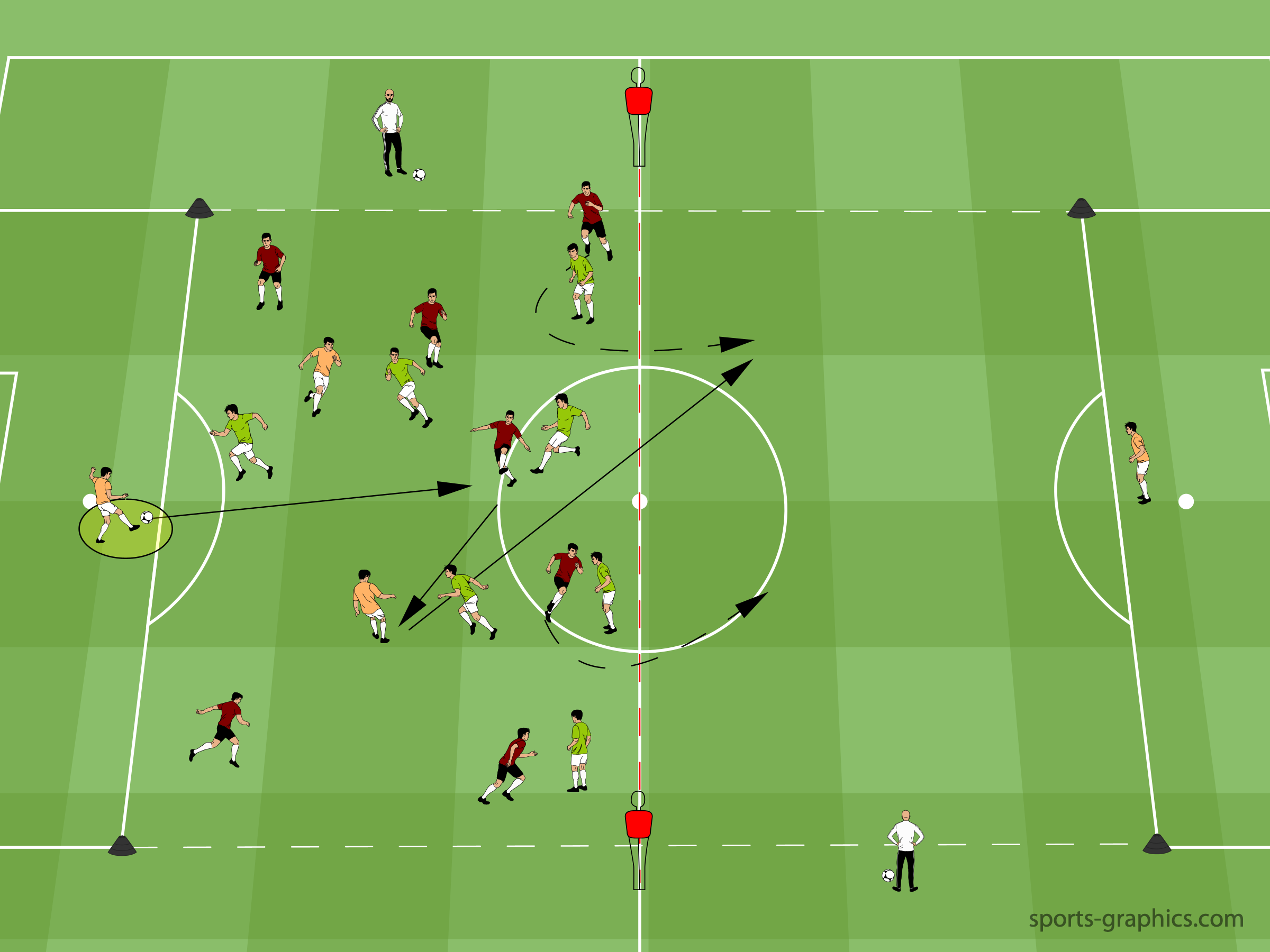
How to Coach High Pressing: From a Single 1v2 Duel to a Full 7v7+4 Training Game
Most coaches teach high pressing one of two ways, and both leave a gap. Some isolate it — a clean shape drilled against a passive opponent, easy to coach but nothing like the chaos of a real match. Others just throw the team into an 11v11 scrimmage and hope the pressing habits they've talked about on the whiteboard show up on their own. They usually don't.
The fix isn't picking one approach over the other. It's sequencing them. Isolate the exact individual moment that pressing depends on until it's automatic, then rebuild that same moment inside a picture big and messy enough to actually resemble a match. This piece walks through both halves of that progression — one small foundation game, and the large-scale version it grows into.
As Jürgen Klopp put it, "pressing is the best playmaker" — but that only holds up if the pressing itself is actually trained, not just demanded from the touchline.
The Foundation: A 1v2 Pressing Duel
Setup
Mark out a grid with a defined line at the far end — something in the range of 10 to 15 metres deep is a reasonable starting point, adjustable up or down based on your players' level. You need one defender, two attackers, and a coach with a supply of balls to feed in.
How it plays
The coach starts each rep by playing a ball into one of the two attackers. The moment that pass is played, the defender presses. The two attackers try to combine — using width, a give-and-go, a third-man idea, whatever gets them there — to beat the lone defender and get the ball across the line at the far end. The defender's job is to apply enough pressure that they never get there: win the ball outright, force it backward, or simply deny the line.
The difficulty lever
The length of the coach's entry pass controls how hard this is. A longer feed gives the defender more time to close the distance and actually arrive with real pressure before the attacker's first touch — which makes a clean press genuinely achievable. A short, sharp entry pass compresses that window brutally, forcing the defender to press from a much tighter starting position with far less margin for error. If you want to dial the difficulty up or down mid-session, this is the one variable to touch.
What to coach
Teach the defender to read the flight and length of that entry pass as their actual trigger — the moment to explode into the press starts the instant the ball leaves the coach's foot, not when it arrives. Coach the angle of approach so the defender presses the attacker toward their weaker side and away from the second attacker, rather than running straight at the ball. And make the point explicit: pressing here isn't just about closing down the ball carrier, it's about denying the two attackers the time they need to combine at all.
Scaling It Up: The 7v7+4 Version
Setup
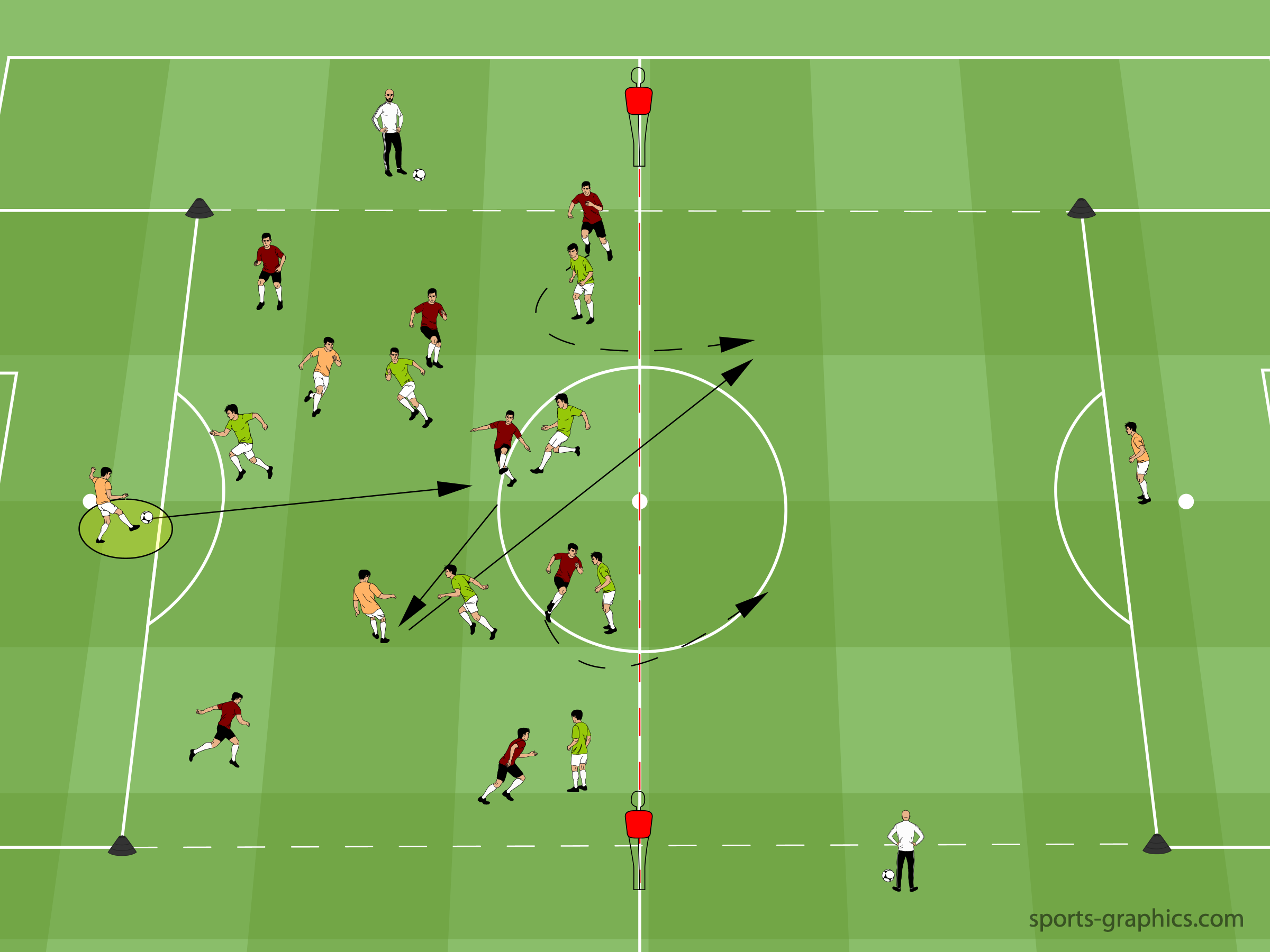
This one is a different scale entirely. Mark a long, narrow channel — its width matching the penalty box, running the full length of the pitch from one box to the other. Position one target player at each end, inside or near the penalty area. Add two overload players who float freely in the channel and play for whichever team currently has the ball. That's seven outfield players per side plus the four extra — two targets, two overloads — giving you the full 7v7+4.
How it plays
Play is confined to one half of the channel at a time, with offside enforced at the halfway point. The team in possession uses its overload players to try to progress the ball into the other half. Reaching it doesn't end the phase — the attacking team keeps the ball and simply reverses direction, now working back toward the half they just came from, aiming at the target player positioned there. Because the direction keeps flipping, the defending team never gets to settle into one static shape; they have to keep rebuilding an organized structure to press from, over and over, phase after phase. If the defenders do win the ball, they can't just break forward blindly — they first have to find one of the wide outlet players to establish a new direction of play before they can progress themselves.
What to coach
This is where it's worth being explicit with your players about what's actually happening: the exact 1v2 pressing principle from the foundation game is buried inside this picture, repeating itself in miniature every time the ball reaches an overload player or a target player. Whoever presses that moment has to make the same read — when to explode, what angle to press from, how to deny the combination — that the isolated drill trained in the first place. What the small game can't teach on its own is the layer this version adds: how fast your team can reorganize its shape every time the direction flips. That reorganization speed, more than any individual duel, is usually what separates a team that presses well from one that just presses hard. And don't let the moment right after winning the ball slide — finding the outside player first, before trying to break forward, has to become a discipline the team defaults to, not something they remember to do only when a coach shouts it.
Why the Progression Matters
Neither piece of this works especially well on its own. Train the 1v2 duel in isolation forever, and your players get sharp at a picture that never quite exists in a real match — no shifting direction, no numbers to track, no larger structure to hold. Skip straight to the 8v8+4, and most players won't have the individual pressing trigger clean enough yet to execute it inside all that noise. Sequenced together, the small game builds the reflex, and the big game asks that same reflex to survive contact with real complexity — which is the entire point.
If you want more standalone reps of that individual reaction before scaling up, two shorter pressing games built around the same reaction-speed idea are worth adding to the same week. The broader logic here — isolate one duel, then dress it up in progressively more realistic context — is also the exact thinking behind our piece on turning a simple 1v1 into three different match pictures, just applied at a much larger scale.
Try This Progression in Your Next Session
Start with the 1v2 duel for ten minutes to sharpen the individual trigger, then move straight into the 8v8+4 and watch whether that same trigger actually survives the bigger picture. The gap between how clean it looks in the small version and how it holds up in the large one will tell you exactly what to coach next.
If you run this progression with your team, let us know how the transfer looked — and share it with a coach who's still trying to teach pressing with a shape on a whiteboard and nothing to back it up.