
A soccer practice tournament turns a normal session into a competition: several small teams, short games, a schedule and a table. It works because your players have to apply what they have learned under pressure and with one clear goal, which is to win. This guide shows when a tournament fits into training, how to set up teams, game length, fields and scoring, and how the new Tournament mode in Saideline builds teams, schedule and table from your squad.
When a practice tournament makes sense
A tournament is not only something for the last session before a break. These five situations come up in almost every season:
- End-of-session tournament: After the main part, a short tournament shows whether the topic of the day holds up in a real game.
- Tournament day: The whole session is one tournament, with a schedule from the first to the last minute.
- Camp: Many players, several fields and a fixed timetable. Here a schedule and a table save the most work.
- Warm-up tournament: Very short games on small fields get everyone moving and competing right away.
- Indoor tournament: Little space, small teams and mini goals. A clear plan keeps waiting times short.
Why competition belongs in training
Most training forms are there to teach something. A competition has a different job: it tests whether your players can call up what they have learned when the result counts. In that sense it is close to match day. There is a clear target, and you coach very little. You watch instead, and you see which behaviors already work without your help. More on this idea in soccer drills that transfer to match day.
Three things make a competition work:
- Announce the target first: A fixed game length, a number of goals or a number of attacks. Your players need to know before kick-off what decides the game, because that creates the urgency.
- Enforce the rules: In a learning form you might let a ball that is slightly out run on, so the action can continue. In a competition you can't. You are the referee.
- Use small rewards: A small prize that fits the age group raises the commitment further.
How to design a soccer practice tournament
Team size. Small teams work best. In a 4v4, every player is responsible in every moment, and a small mistake is punished with a goal right away. Players also get far more technical and tactical repetitions than in bigger games. That is why small formats fit every age group, from young children to adults. You will find more ideas in the guide to small-sided games.
Balanced teams. The normal case is an even balance of strength between the teams. You can also fix positions inside the teams to create specific 1v1 matchups. If you want to try something different, let a stronger team play a weaker one and give the weaker side a head start of a few goals. Combined with a short game, the underdog has a real chance.
Game length. Short games keep the pressure high, because every action counts. For 1v1 competitions, rounds of one to two minutes are enough. For team games, the chips in the Saideline Tournament mode suggest 5 to 12 minutes per game. You can write any other length into the prompt.
Fields and goals. Run games in parallel on several fields so that nobody stands around. The type of goal changes how your players behave. If a team scores by dribbling over a line, defenders can defend more patiently. With big goals and goalkeepers they have to put pressure on the ball, because every shot is a threat. The same applies in 1v1 games.
Restarts. You get more playing time if you replace throw-ins and other set pieces with a restart from the goalkeeper or a pass from you.
Scoring. Three points for a win and one for a draw is the classic. These variations change the character of the tournament:
- Ladder: After every round, winners move up one field and losers move down one. After a fixed number of rounds, the winner on the top field wins the tournament.
- Total goals: All goals from all rounds are added up. If two teams are level, they play a final.
- Zone points: A goal counts more the farther away it is scored. A team that is behind can still come back late in the game.
- First to x goals: Not the clock decides, but the score.
One more hint for a tournament day: reduce what you say. A few basic principles and clear roles are enough. The games do the rest.
Three formats: round robin, groups plus final, knockout
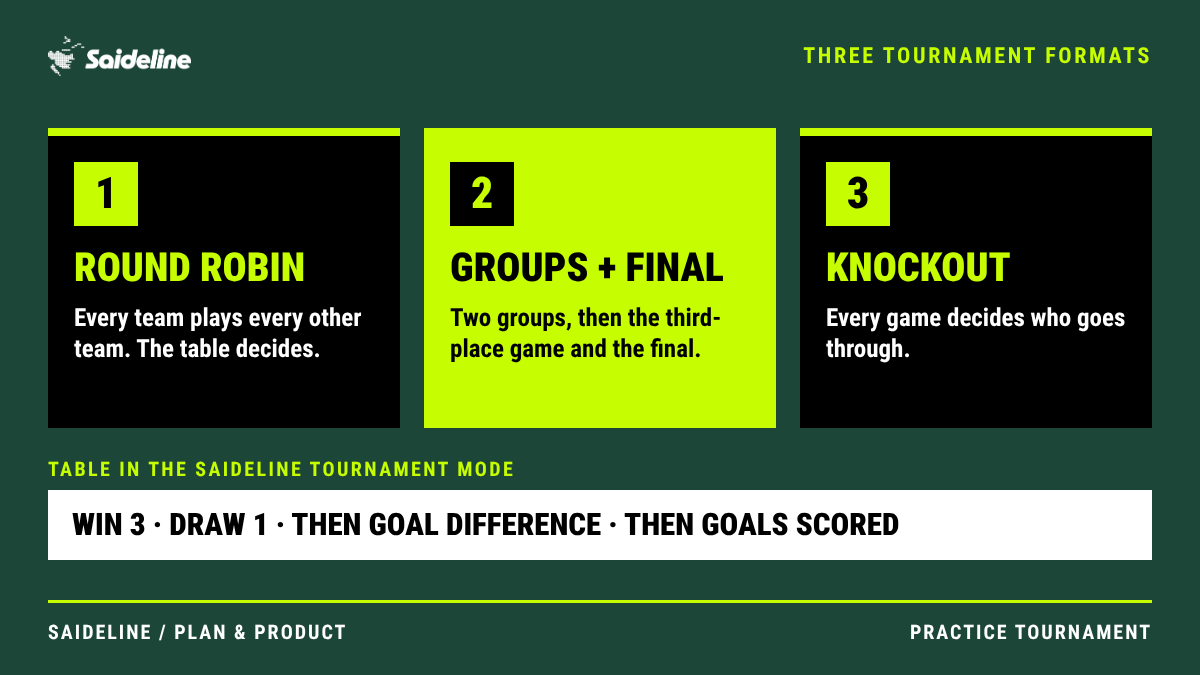
- Round robin: Every team plays every other team, and the table decides. All teams play the same number of games. In Saideline this format is called Everyone vs everyone.
- Groups plus final: Two groups play first. After that come the third-place game and the final. This gives the tournament a clear high point.
- Knockout: Every game decides who goes through. This format is the closest to the pressure of a decisive match.
The Tournament mode in Saideline
Balancing teams, working out a schedule and keeping a table by hand costs time you would rather spend on the field. The Tournament mode takes over this part. Saideline builds your tournament from your squad:
- Select @Tournament in the prompt field on the start page and describe the tournament in your own words, for example "4 teams, squad, groups + final, 6 min". The chips below the field are only suggestions. You can write other values too, for example a different number of teams or minutes, and a matching chip appears.
- Check the settings. A confirmation bar shows what was understood. With Change you open the settings: players (a number or your saved squad, including goalkeepers), teams, format, game length, pitches and goals (mini goals, with goalkeeper or line). If the goals are still missing, Saideline asks for them.
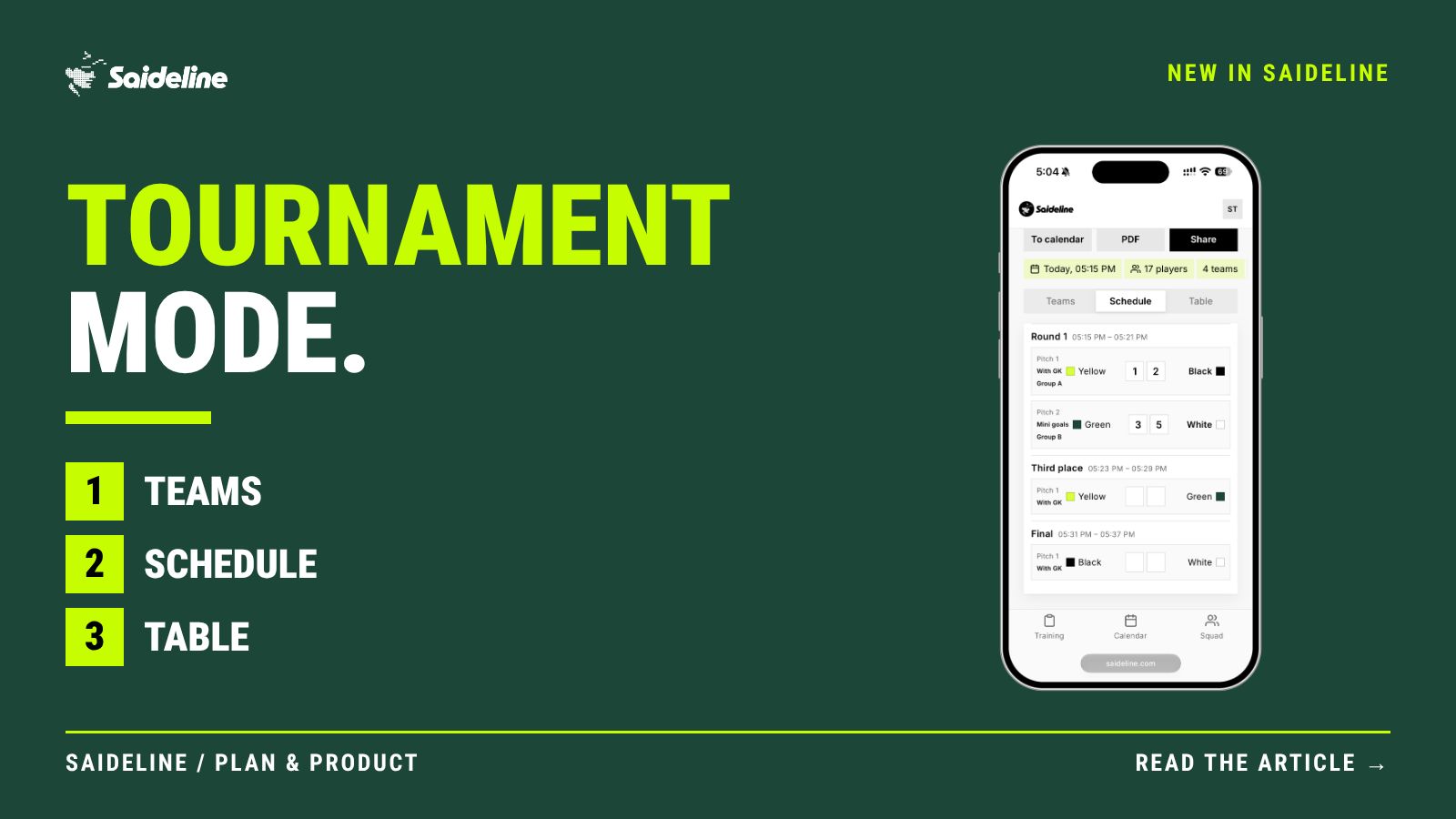
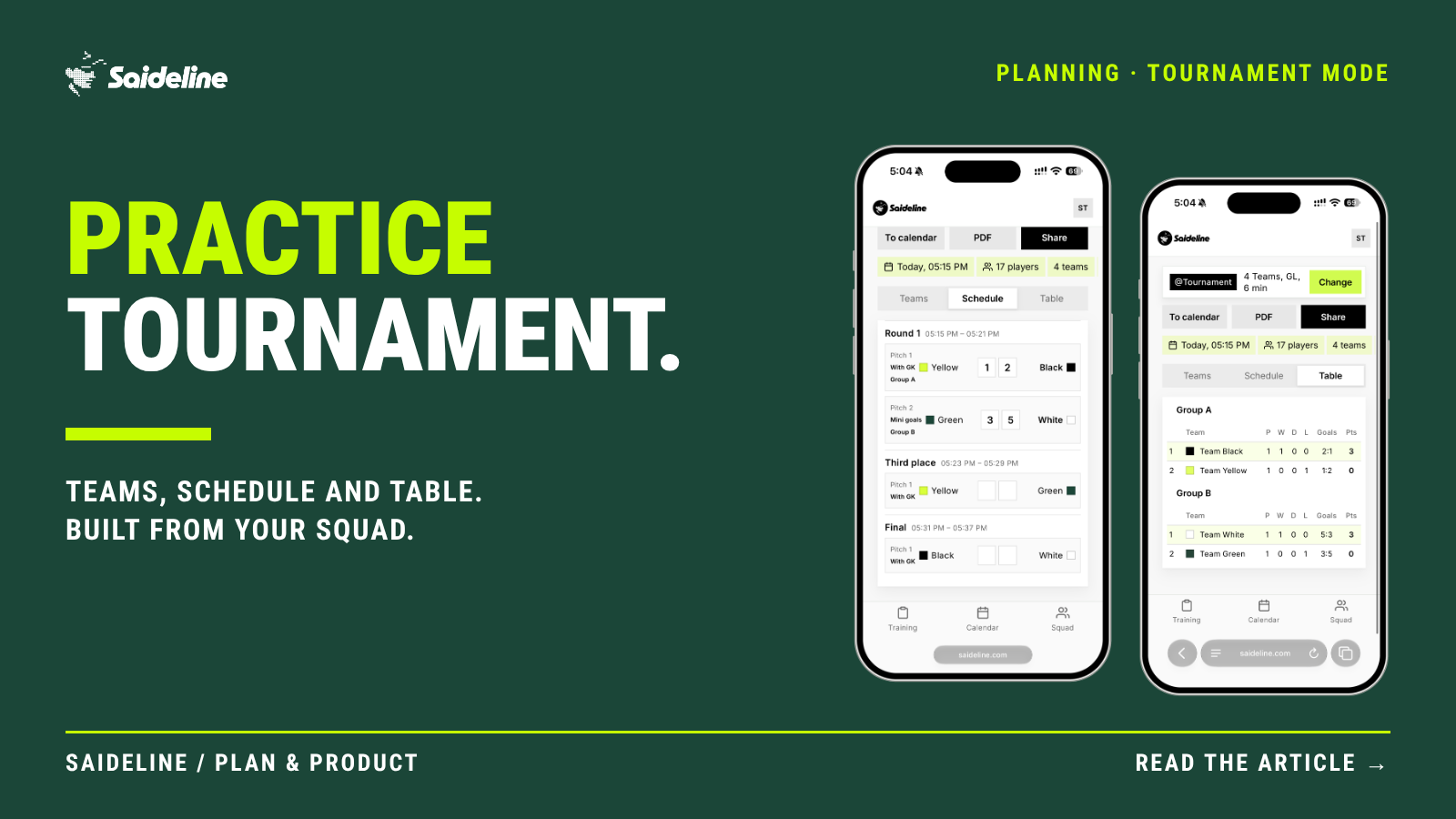
- Create. You get a finished page with three tabs: Teams, Schedule and Table.
- Enter the results. Every game has two boxes for the goals. The table keeps up.
- Take it with you. Use the buttons To calendar, PDF and Share.
This is what the page contains:
- Teams: Your saved squad players are distributed automatically, balanced by position and strength. Each team has a color, and the goalkeepers are assigned per pitch. How the squad itself works is explained in soccer coaching software that builds your teams.
- Schedule: Rounds with start and end times, games on several pitches at the same time and a note for each pitch, with goalkeeper or mini goals. In the format with groups and a final, the pairings for the third-place game and the final are set from the start and fill in with the results.
- Table: Games played, wins, draws, losses, goals and points, with one table per group. A win brings 3 points, a draw 1. If teams are level, goal difference decides, then goals scored.
- PDF: A printout with the teams, the schedule with boxes for the results, the table and space for notes. You can run the whole tournament on paper at the field and fill in the results by hand. For normal sessions there is the printable practice plan.
- Calendar: To calendar adds the tournament as a session to your Saideline training calendar.
- Share: You can share the tournament with anyone, the same way you share your sessions.
The Tournament mode is available in English and German. For your regular sessions nothing changes: the game forms come from professional coaches with many years of experience, and AI combines them into your session. One example is the update with 50 new youth game forms.
Frequently asked questions about practice tournaments
How many teams do I need for a soccer practice tournament? The chips in Saideline suggest 2, 3, 4 or 6 teams. Other numbers work too if you write them into the prompt. With four teams and two fields, all teams play in every round.
How long should a game last? Keep it short, so that every action counts. In Saideline the chips suggest 5 to 12 minutes per game, and you can enter any other length in the prompt. For 1v1 competitions, one to two minutes per round are enough.
Which format fits my group? Round robin if every team should play the same number of games. Groups plus final if you want a clear high point. Knockout if you want the most pressure.
Do I need goalkeepers? No. You can play on mini goals or over a line. If you have goalkeepers, you can use them on one pitch and play with mini goals on another.
Can I run the tournament without a screen? Yes. The PDF contains teams, schedule, table and boxes for the results, so you can fill in everything by hand.
Conclusion: let your players compete
A soccer practice tournament shows you what your players can do when it counts. Keep the teams small and balanced, the games short and the rules strict, and choose the format that fits your goal for the day. Then step back and watch.
If you don't want to work out teams, schedule and table by hand, describe your tournament in Saideline and let it be built from your squad. Saideline runs on the web and costs 9 € per month or 90 € per year, including VAT. You can try it with 3 free sessions and without payment details. How a complete session comes together is explained in how to plan a soccer practice.