
A good soccer warm-up gets players ready for what comes next: sprints, braking, changes of direction, duels. If your routine is a few laps and then a ball thrown into the middle, you are giving away a lot of useful time. This article builds the warm-up from six blocks, shows how they become a routine of twelve minutes at most, and gives you a fixed sequence for match day. For warm-up games with the ball, see Passing Warm-Up Drill: Turn a 1v1 Into a 2v1. This piece is about the frame around them.
What a good warm-up has to do
A warm-up has three jobs. Everything you include should serve at least one of them:
- Raise performance: Body temperature rises, tissue becomes more pliable, the pulse climbs and the muscles get more oxygen. There is also an effect many coaches underestimate: warm players move with better coordination and scan the pitch more alertly. The warm-up is a ritual, too. It switches the mind into training or match mode.
- Prepare for the load: The movement patterns you are about to need are called up in a small dose first: changes of direction, turns, landings, short accelerations. A warm-up does not replace an injury-prevention program, but it can prepare the patterns before they are demanded under pressure.
- Match what follows: Before an intense 3v3 the body needs something different than before a relaxed technical block.
A warm-up is not fatigue. If players crawl into the session, the goal was missed. A simple check is a scale from 1 to 10: ask your players after the warm-up how hard it felt, where 1 is a walk and 10 is maximum effort. As a rule of thumb from practice, 3 to 5 is a good range. At 7 or 8 it was too intense, so adjust next time. Faces tell you a lot as well: a bright red face and heavy breathing are too much, and a player who is not sweating yet is still cold.
Two levels: before training and on the pitch
You can split the warm-up into two levels. Before training, each player prepares individually. Everyone brings their own restrictions, for example at the hip, knee or ankle, and for goalkeepers often at the shoulder. A squad rarely has just one problem area, which is why "everyone does the same thing" works poorly. On the pitch, the whole team then does the shared, soccer-specific preparation together.
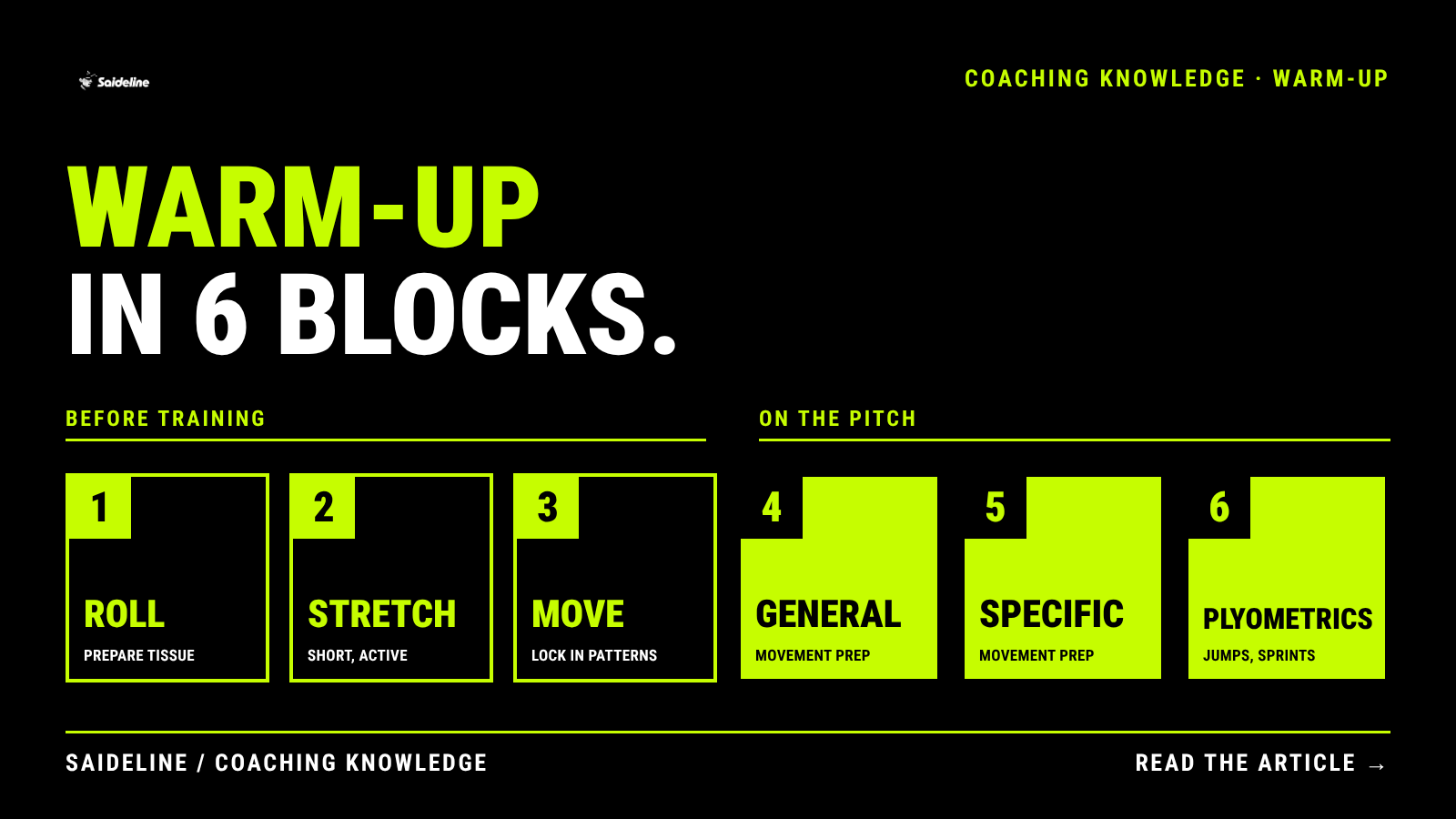
These two levels give you six blocks: three for the individual preparation, three for the pitch.
Before training: roll, stretch, move
These three blocks need very little equipment and can happen in the locker room, the hallway or at the edge of the pitch. Anything that fits in a bag works: a foam roller, a small hard rubber or lacrosse ball, a mini band.
- Roll (prepare the tissue): With a foam roller or a small ball you work on muscle and connective tissue. After an intense session the muscles often feel tighter the next day, and rolling can free up range of motion for a short time. Here is a self-test to try: stand upright with your feet together and, keeping your knees straight, reach your fingertips toward the floor as far as you can. Note the distance. Then roll the sole of one foot with a small ball for 90 seconds and repeat the test. Many people get lower. That is an observation from practice, not proof of a particular mechanism.
- Stretch (short and active): Soccer demands large ranges of motion: long strides, sprints, shots. The muscle should get ready for that, not relax. So before training you stretch briefly and actively by tensing the opposite side. If you tense the front of the thigh, for example, the back of the thigh lets go more easily. Long static stretching before maximal effort is debated critically, so keep it short and keep it active.
- Move (lock in what you unlocked): The range of motion you have just opened up is secured in a pattern. Closed-chain exercises work especially well, where the moving limb stays in contact with the floor or a wall, such as the single-leg airplane balance.
A simple formula to remember is "roll, stretch, move": every routine contains at least one exercise from each of the three blocks. Which ones depends on the risk profile of the individual player.
On the pitch: movement prep and plyometrics
The shared preparation follows one clear line: from slow to fast, from simple to complex, from general to soccer-specific.
- General movement prep: Sport-neutral exercises that activate the trunk and train force transfer between hands and feet, for example with a mini band or in crawling patterns.
- Specific movement prep: Soccer patterns in every direction: up, down, sideways, with a turn. This is more than a classic running drill. The point is active mobility in the patterns you are about to use. A handball throwing pattern has no place here, except for goalkeepers.
- Plyometrics: Jumps, short sprints and other fast, explosive movements close the warm-up. They wake up the nervous system and prepare tendons and ligaments for maximum load. A competition such as a sprint duel or a tag game is plyometric, fun and emotional. More ideas are in 1v1 Soccer Drills: 5 Competitive Games for Better Duels.
Two principles help when you design this part. First, the same patterns in changing situations: players practice one movement pattern but with different tasks and partners, so it stays fresh. Second, if a player cannot manage an exercise, you change the task or the environment, meaning the organization, the instruction or the equipment, and not the player.
Building a 12-minute routine
In amateur and youth soccer, time is tight, and school and work come on top. That is why the individual routine should stay short. These values come from practice:
- Twelve minutes at most, six to eight exercises. Short and regular beats long and rare.
- Form groups: by focus (ankle, knee, hamstrings) or by arrival time. Players who arrive together start together.
- Explain the purpose: Players who do not know why they are doing something quit after three or four sessions.
- Be patient: Give a routine eight to twelve weeks before you expect effects. When it works, the next topic is next.
Which topics first? In soccer, the back of the thigh, the groin, the knee and the ankle are common load points. For knee and ankle, control of the leg axis often plays a role, meaning how well someone lands, brakes and jumps. For exactly these five areas you will find ready-made routine sheets below.
Match-day warm-up: 25 minutes in a fixed order
On match day, certainty counts. You control your own preparation, not the opponent and not the weather. So do not reinvent the warm-up every week. Let a fixed routine run that puts players straight into competition mode. Intensity rises step by step. The times are guide values from practice:
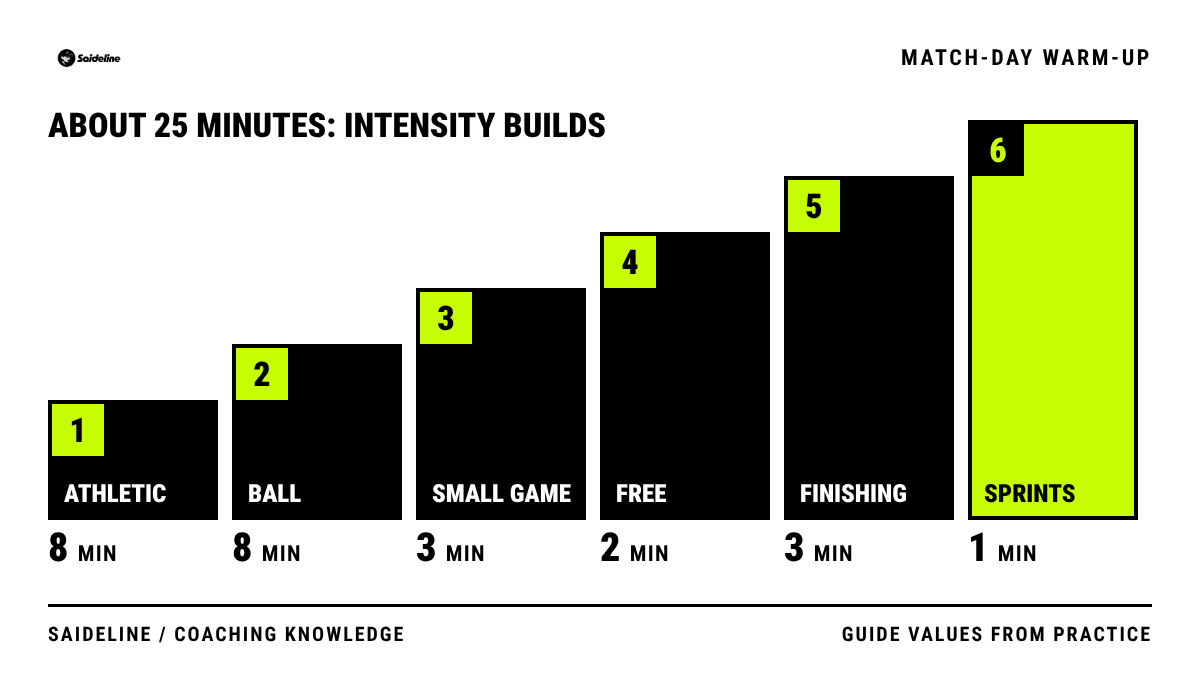
- Athletic activation, about 8 minutes: low intensity, moving through all patterns from general to specific to plyometric. Physically, very little is needed to get warm. As a rule of thumb the body reaches working temperature after six to eight minutes. You use that time to prepare patterns.
- Exercises with the ball, about 8 minutes: passing, getting used to the ball, getting to know the pitch. Toward the end, short and intense rounds with fast dribbling and fast passes.
- Small-sided game, two short rounds, about 3 minutes together: Intensity rises, and changes of direction and turns are provoked. Do not coach at maximum: that is the job of the training week. For ideas see Small-Sided Games: Coaching Drills for Soccer That Do More.
- Free time, about 2 minutes: Everyone does what they personally need: a long ball, a favorite stretch, a personal ritual.
- Finishing, about 3 minutes: Shots and crosses with match-like movement patterns and maximal actions.
- Sprints, about 1 minute: Not volume but intensity. Three to four accelerations over eight to ten meters, in a straight line and with a change of direction.
Together that makes about 25 minutes. The warm-up does not need to be longer. Substitutes can play their own small games at the back of the pitch.
Using warm-up time: 2,400 minutes a year
Here is a sample calculation. Four training sessions a week with 15 minutes of warm-up each and 40 training weeks a year add up to 2,400 minutes. How many weeks you actually have depends on summer break, winter break and weeks without games. You can use this time systematically instead of just "ball in the middle and go". You can train landing, braking, sprinting and changes of direction, and link the warm-up to the focus of the week. How you spread the load across the week is shown in Soccer Training Calendar: Plan Weeks, Load and Sessions.
Routine sheets and a feedback sheet to save
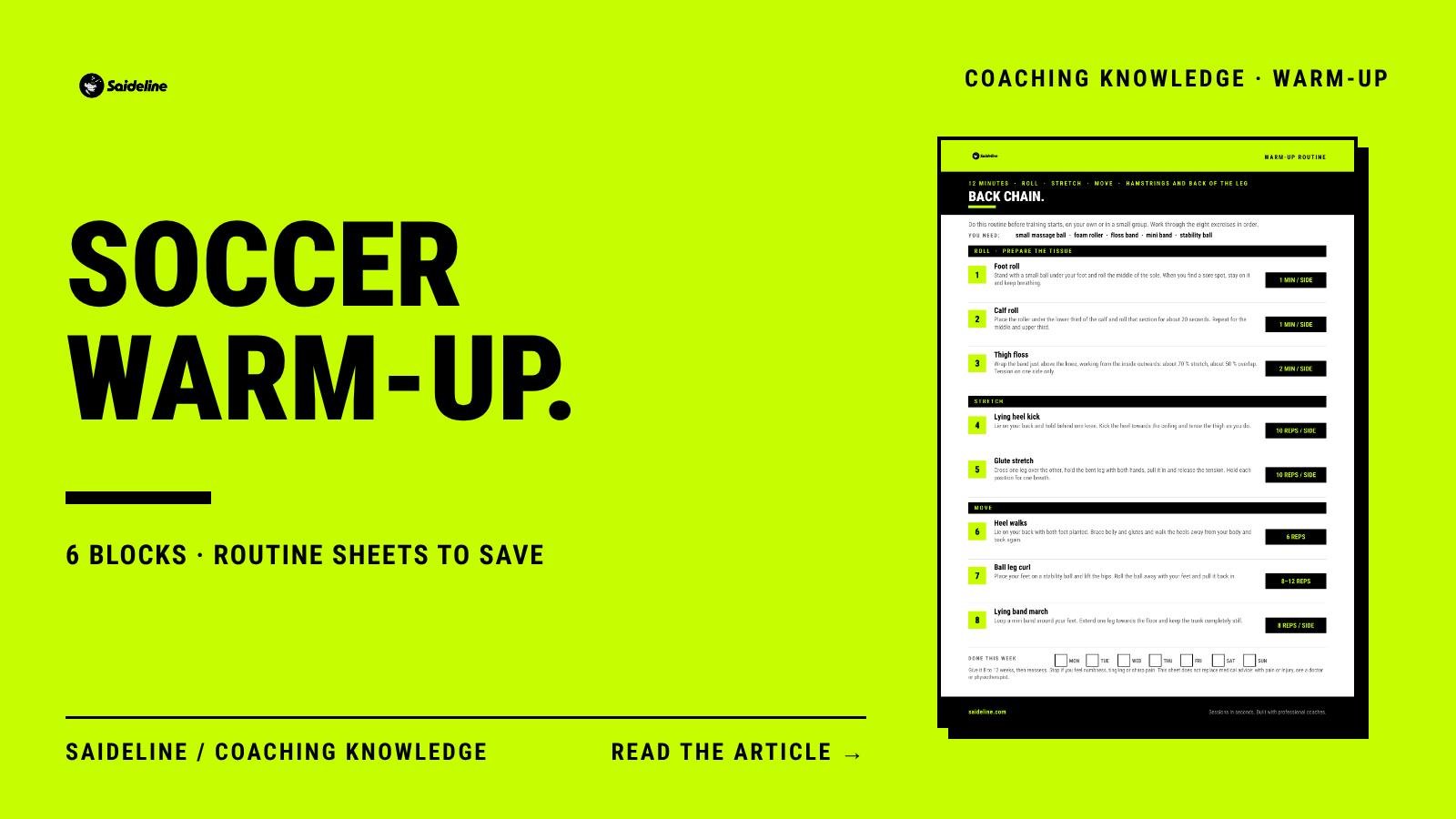
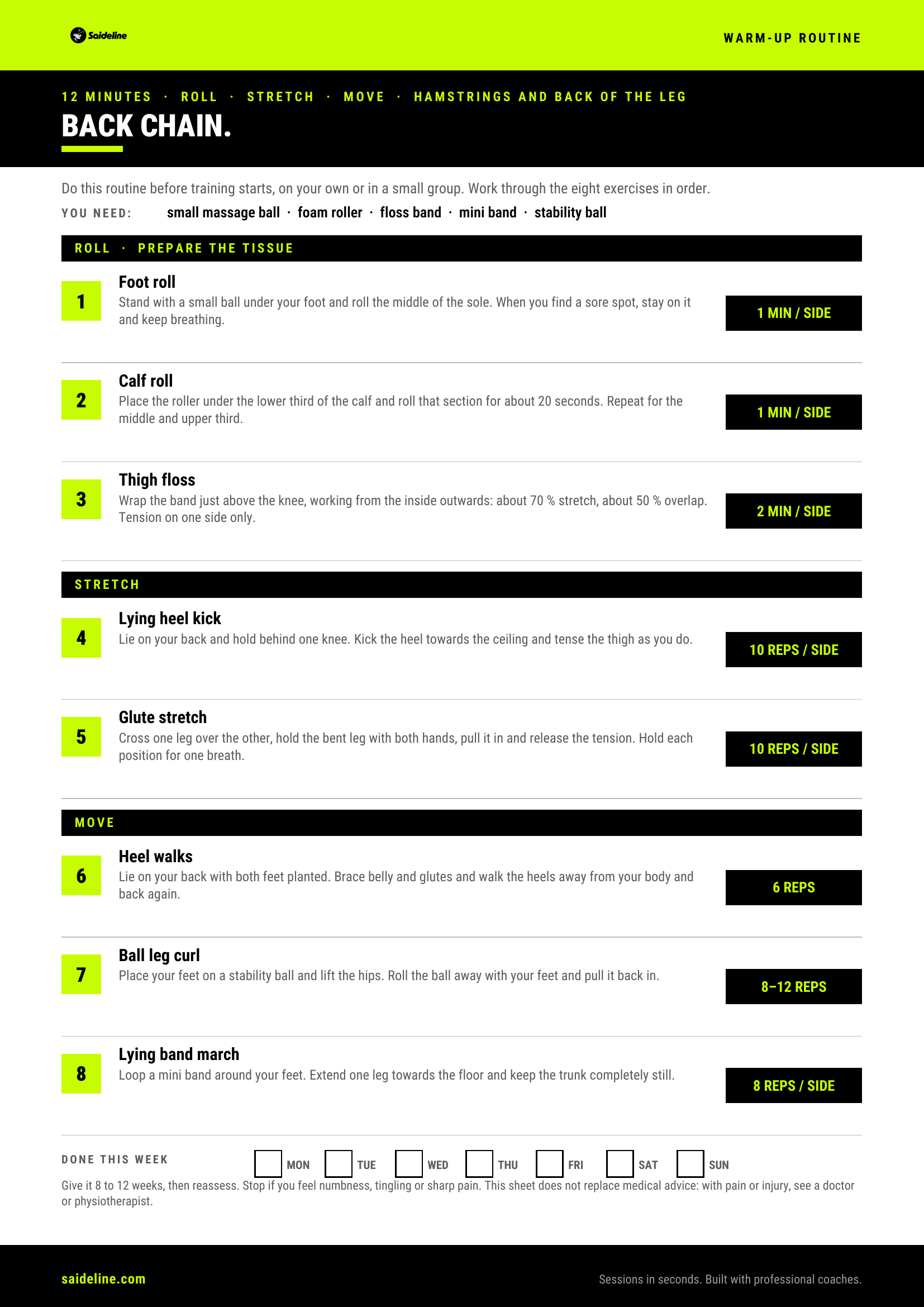
This article comes with five routine sheets for the back chain, leg-axis control, hip mobility, groin and ankle. Each sheet has eight exercises in the order roll, stretch, move, with dosage and a strip to tick off the week. Tap or click an image and save it to your phone or computer to print it or post it in the team chat.
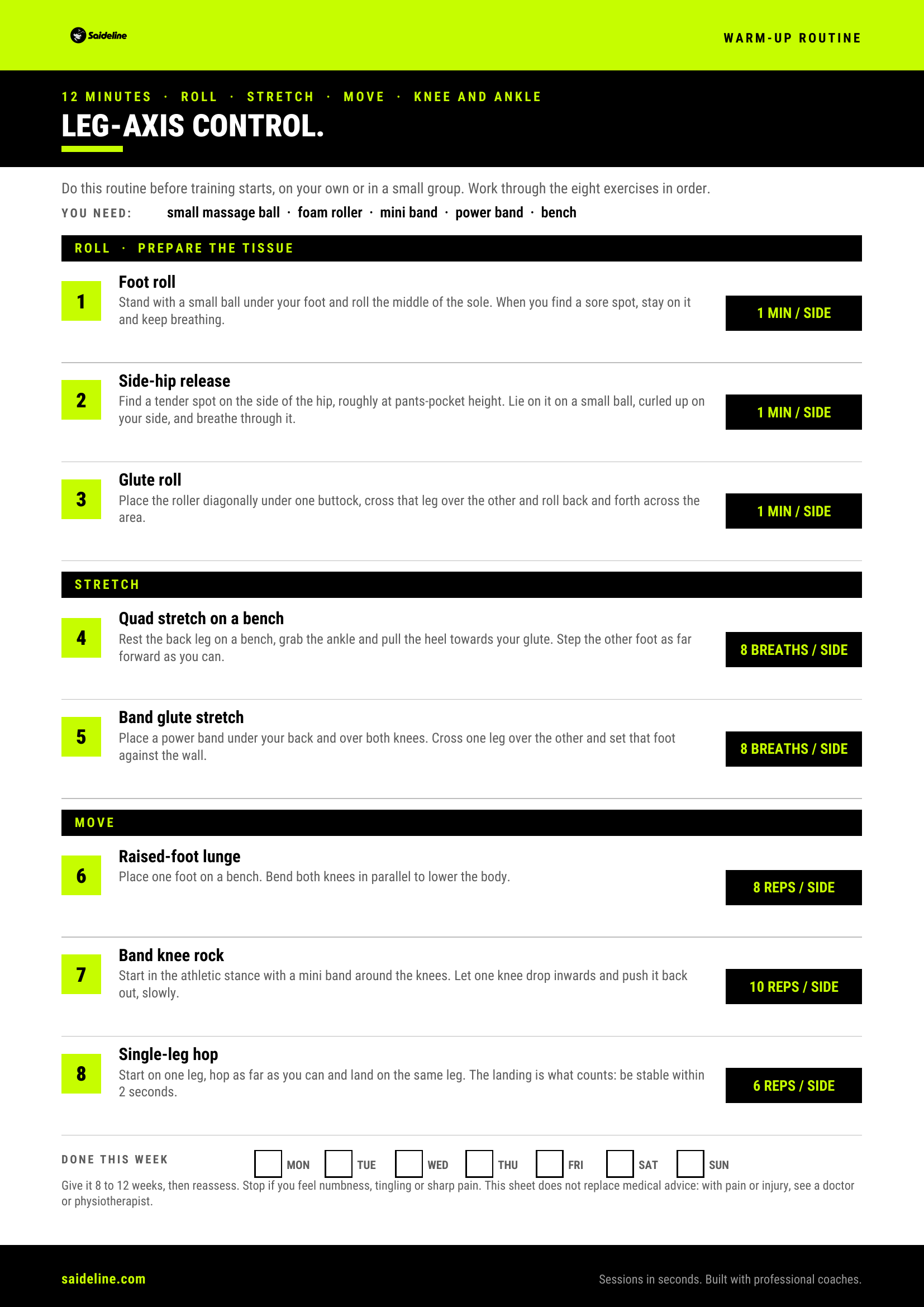
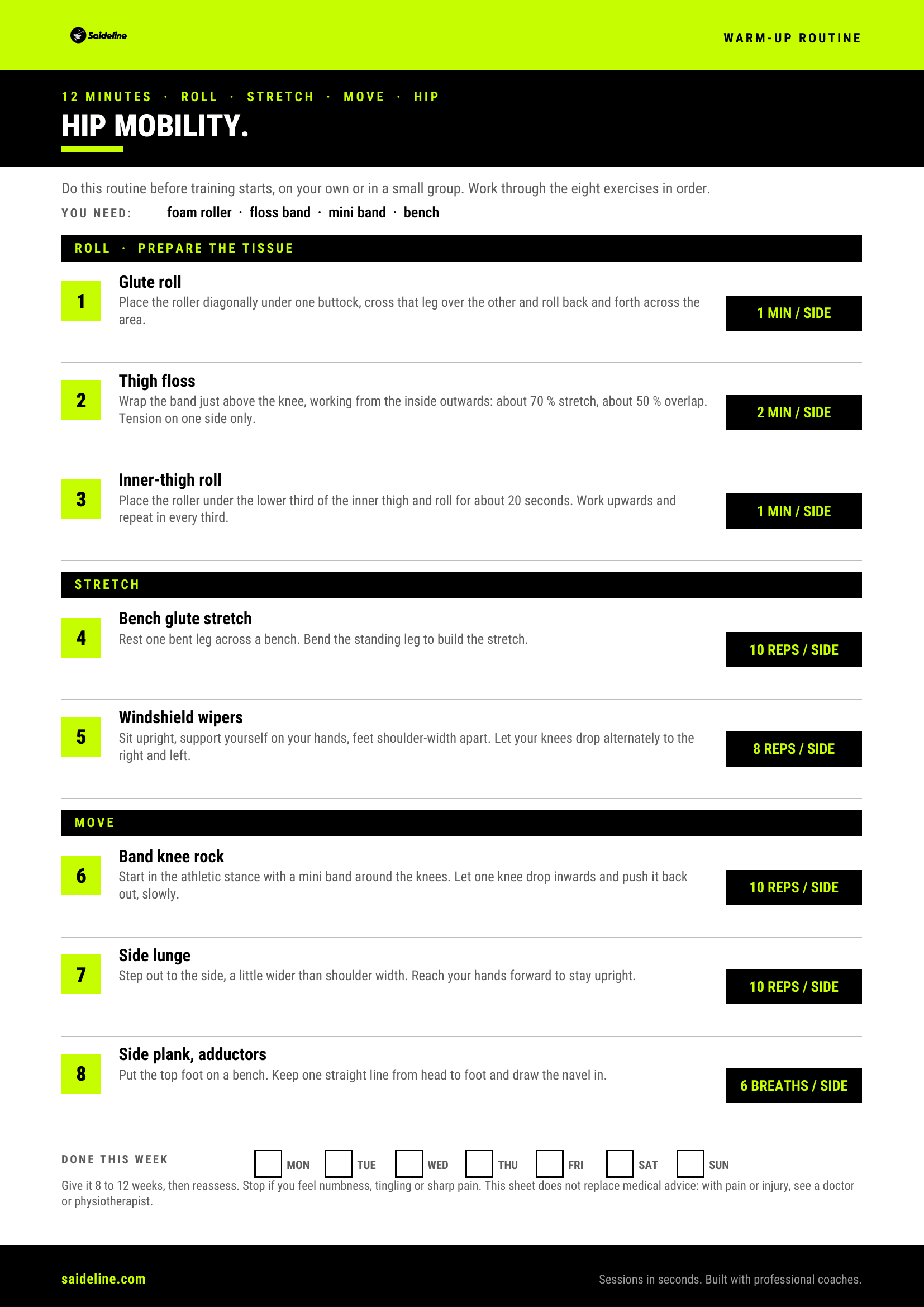
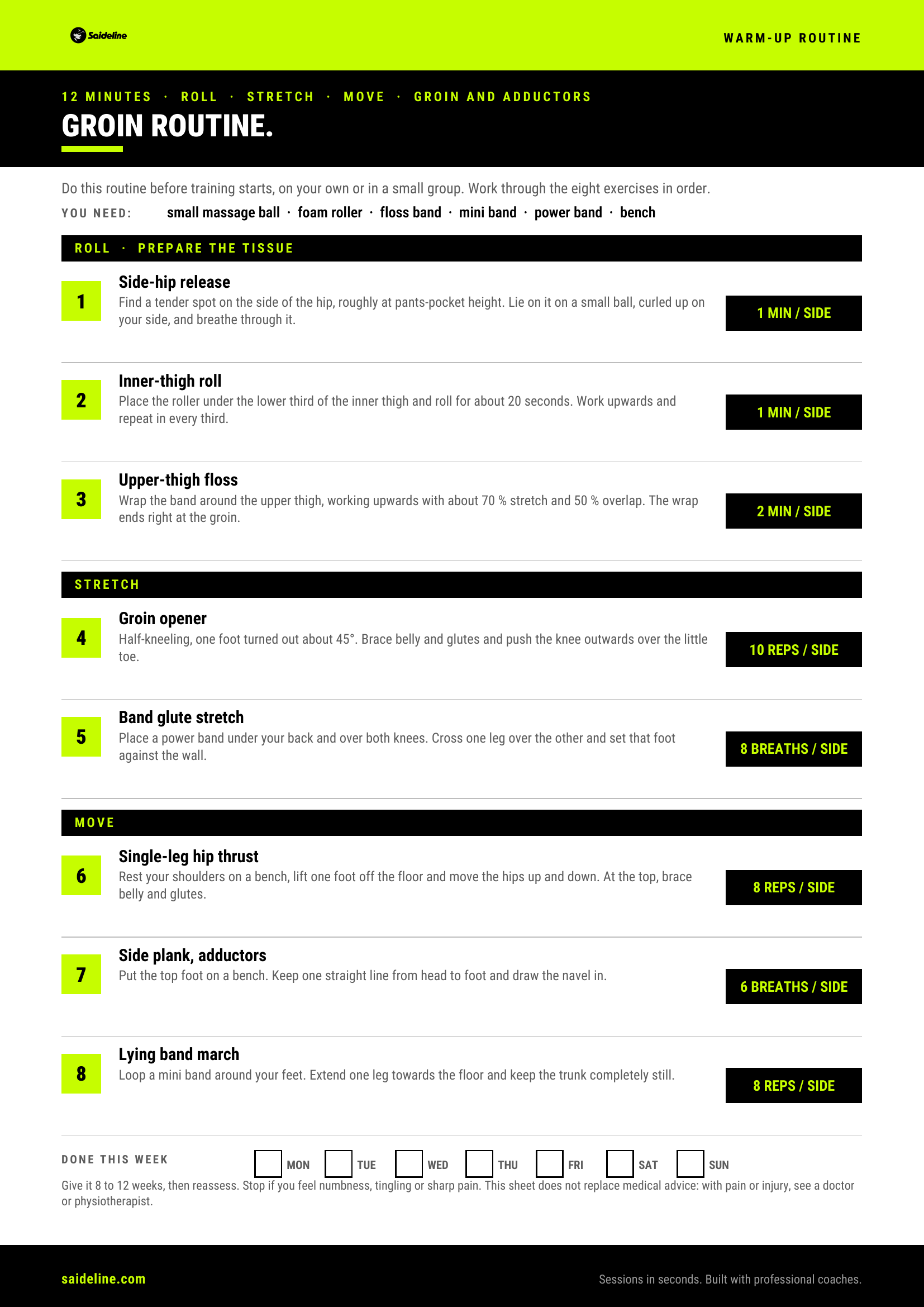
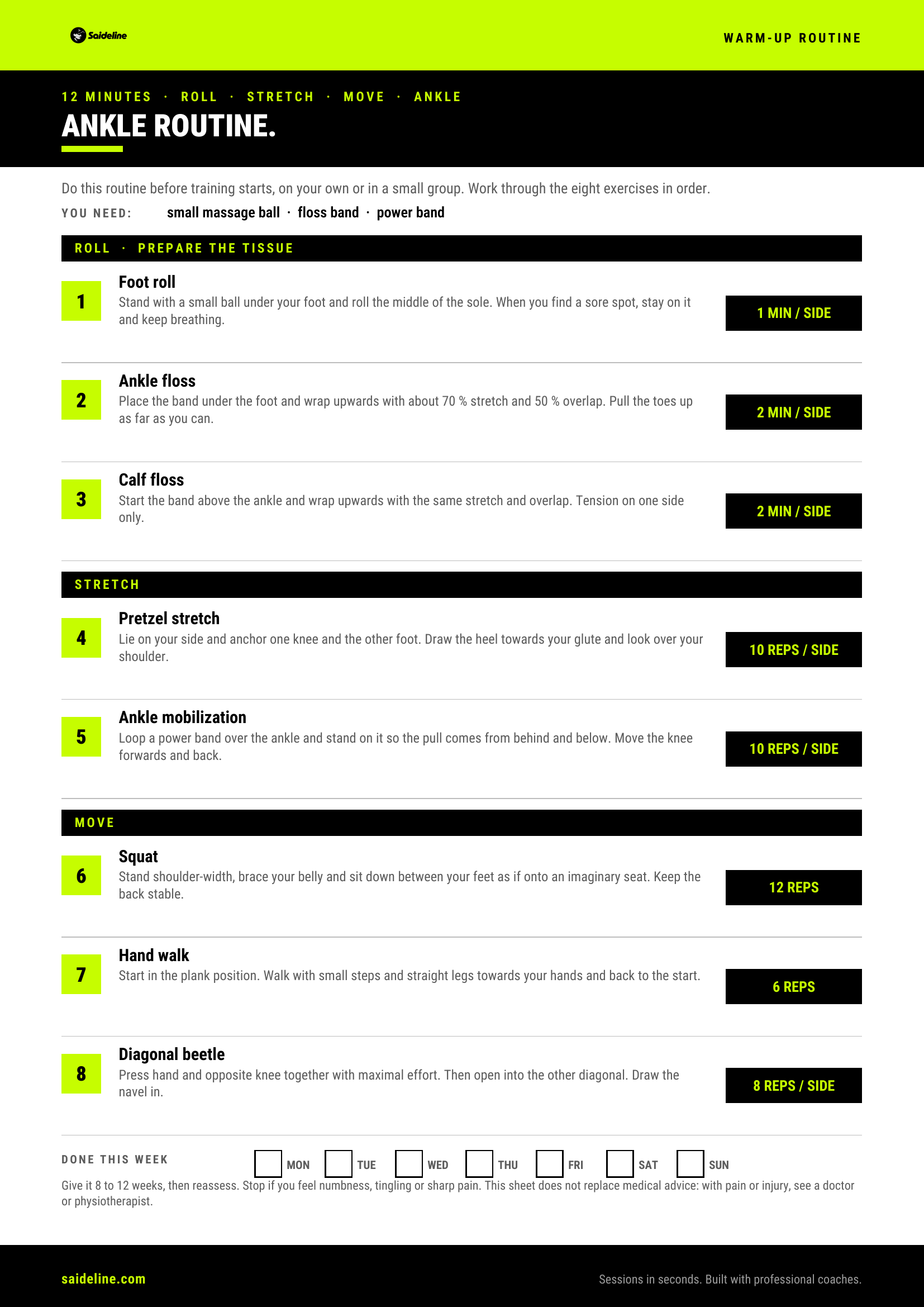
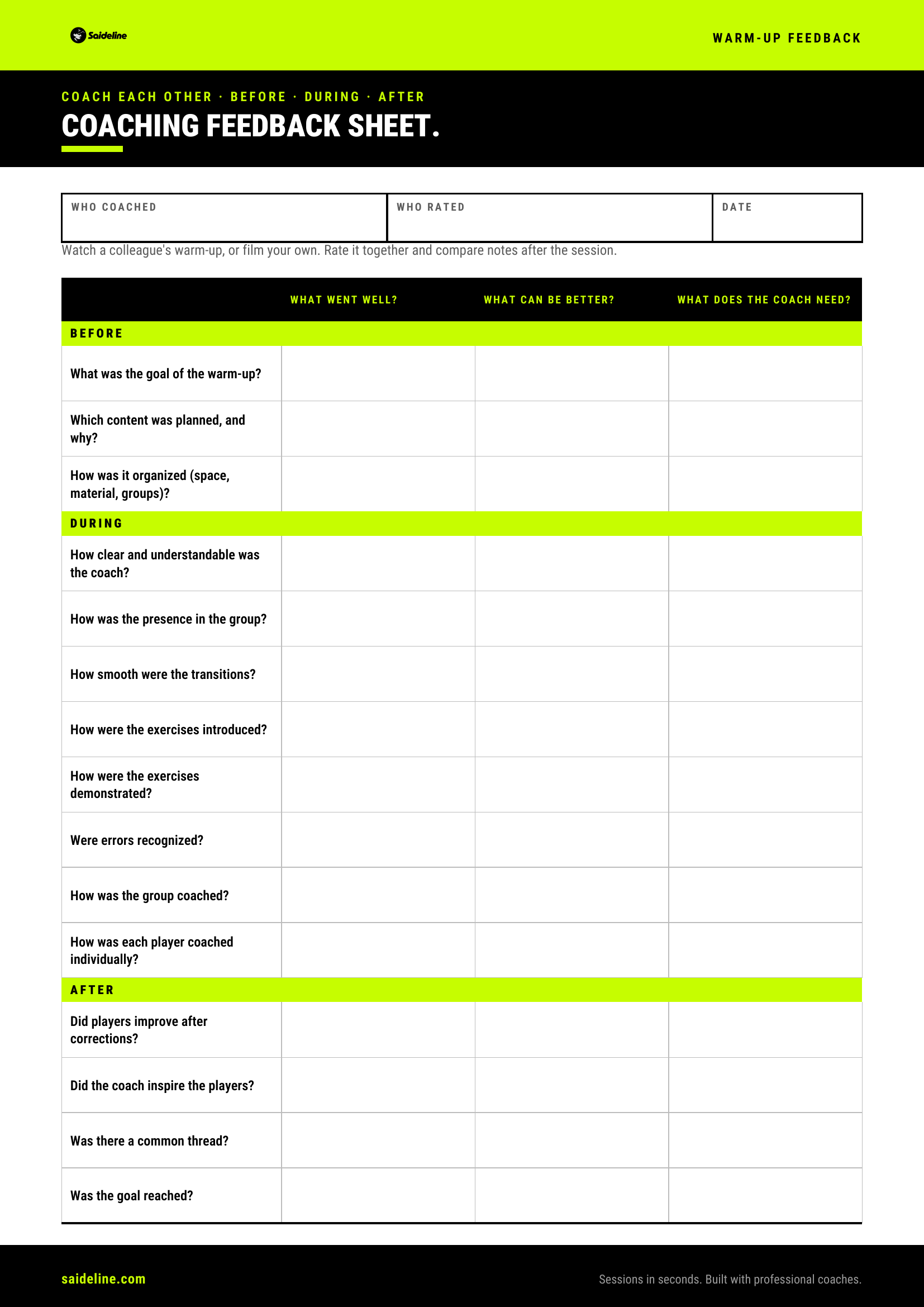
There is also a warm-up feedback sheet for coaching each other, with questions for before, during and after the session. You can watch a colleague's warm-up or film your own and rate it together.
Health and age groups
The content of this article is training practice, not a diagnosis and not therapy. If there is pain, swelling, instability or numbness, a doctor or physiotherapist should assess it, not a warm-up routine. That also applies to bands such as floss bands: with tingling or sharp pain, stop. The principles hold for all age groups. For children and teenagers, though, you should agree dosages for sprints, jumps and bands with qualified professionals and keep the warm-up as playful as possible.
Planning the warm-up with Saideline
You plan the athletic warm-up yourself with the six blocks. Saideline helps with the session that follows: you describe in the prompt what your team should work on, for example changes of direction or transitions, and you get game forms made by experienced pro coaches, which Saideline's AI combines into your session. That lets you match the warm-up to the focus, such as sprinting and braking before a transition game. In the training calendar you set a load of Low, Medium or High for each session, and it feeds into the generated session. How to build a whole session is covered in How to Plan a Soccer Practice: 6 Steps for Coaches.
Frequently asked questions about the soccer warm-up
How long should a soccer warm-up last? The individual routine before training takes twelve minutes at most, and the shared preparation on the pitch usually 12 to 15 minutes. A fixed match-day sequence takes about 25 minutes. These are values from practice.
Should you stretch before soccer training? Briefly and actively, yes, with the aim of preparing the range of motion for strides, sprints and shots. Long static stretching before maximal effort is debated critically.
How intense should a warm-up be? On a scale of 1 to 10, 3 to 5 is a good guide. At 7 or 8 the warm-up is too intense and players start the session already tired.
Which warm-up exercises suit youth teams? The blocks stay the same, but the delivery should be playful, for example with tag games and sprint duels. Agree dosages for jumps, sprints and bands with qualified professionals.
Conclusion: from blocks to routine
A good soccer warm-up is a toolkit: rolling, stretching and moving prepare the body individually, and movement prep and plyometrics bring the patterns onto the pitch. Start small, with one routine for the group and a fixed sequence for match day, and check after eight to twelve weeks what has changed. If you would rather not assemble the session after the warm-up yourself, you can try Saideline with three free sessions and no payment details. After that it costs 9 € a month or 90 € a year, including VAT. Details are in Soccer Coaching App Pricing: Try 3 Sessions Free.