
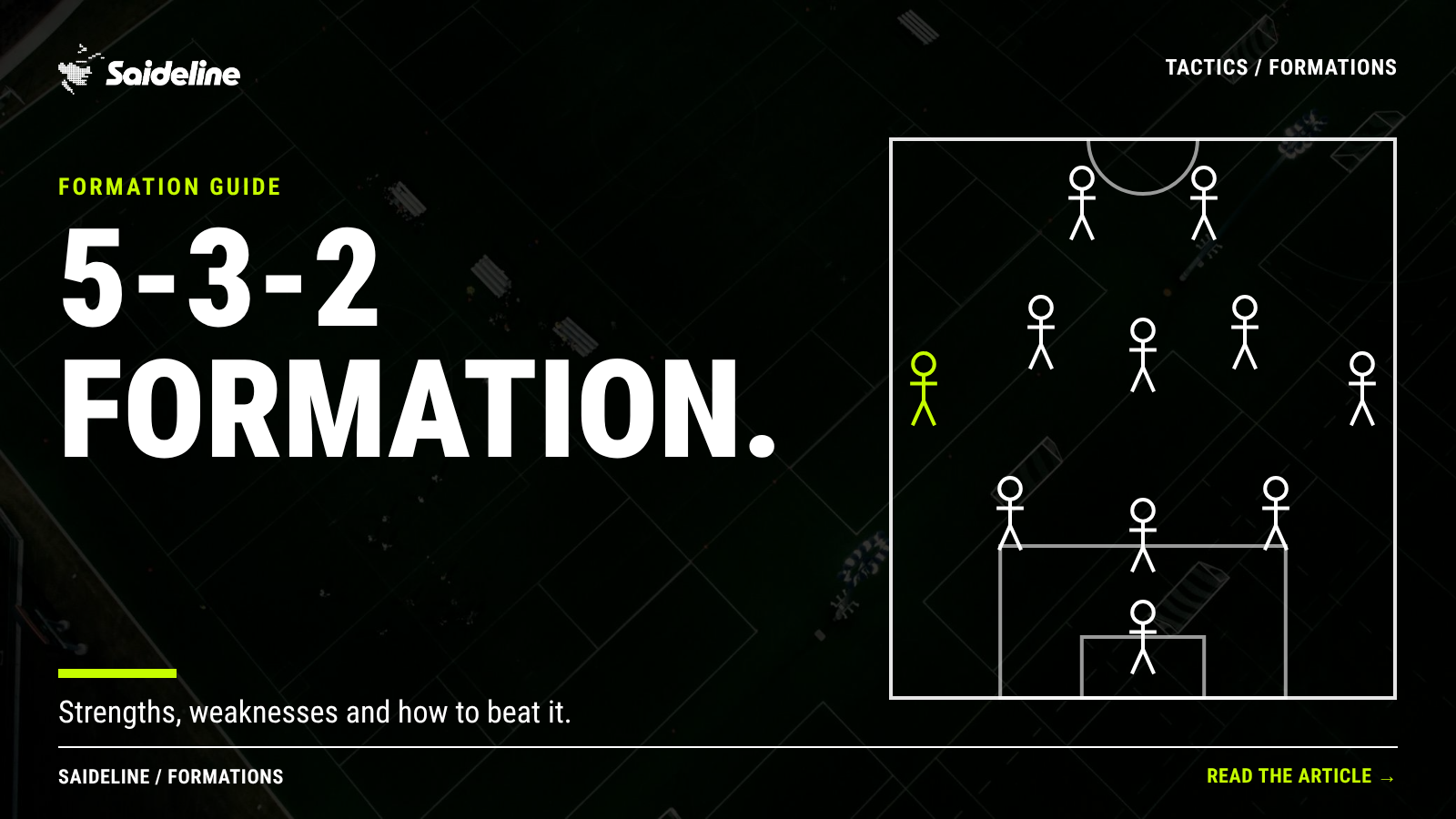
The 5-3-2 puts three center backs and two wing-backs behind a midfield three and two strikers. Count the wing-backs as defenders and you call it a 5-3-2. Count them as midfielders and the same shape becomes a 3-5-2. Coaches choose it for stability, and the back line is hard to pass through. The price is one player fewer in midfield. This article shows how the formation works, where it is vulnerable, how to play against a back five, and which game forms let your players practice all of it.
What the formation looks like
Eleven players, five roles:
- Goalkeeper. Sits behind a compact back line.
- Three center backs. The middle one covers the space behind, the two outer ones can step out of the line into the half-spaces.
- Two wing-backs. They own the full flank. Without the ball they are part of the back five, with the ball they push up and give the team width.
- Three central midfielders. They protect the center and link defense and attack.
- Two strikers. They work as a pair, so the opposing center backs always have to deal with two players.
How the system behaves on a given day depends on the wing-backs. If they stay deep, it plays like a back five. If they push high, it looks like a 3-5-2. The same team can show both shapes within one match. If you want to see how a back three builds from the ball, read the 3-4-3 article on back-three build-up. For the bigger picture on why shapes matter less than principles, see why formations matter less than you think.
Why coaches pick a back five
Looked at from the side that has to play against it, the back five has three clear strengths:
- Smaller gaps. Five defenders leave smaller gaps between them than four. A runner who chases a ball into a gap meets a defender who only has to shuffle sideways, and the dense spacing makes that easy.
- A center back can step out. With three center backs, one of them can leave the line to meet a player between the lines, and four defenders stay behind. The old question of when a center back should step out and who covers him mostly disappears.
- Doubling up wide. A center back from the half-space can help the wing-back in wide duels. A switch of play that aims for a free 1v1 on the wing gets much harder.
Where it is vulnerable
Every advantage has a price, and here it is a missing player in front of the back line:
- Less pressing. With one player fewer in midfield and attack, fewer players can follow when the team presses. Teams in this shape tend to sit deeper almost automatically.
- Width in midfield. Three central midfielders cannot cover the whole width on their own. The wing-backs have to do it, and when they are caught high, the half-spaces open.
- A compact but passive block. A team that sits deep gives you the ball, so the question becomes how to turn possession into chances. That is the same problem as playing against any low block.
How to play against a 5-3-2
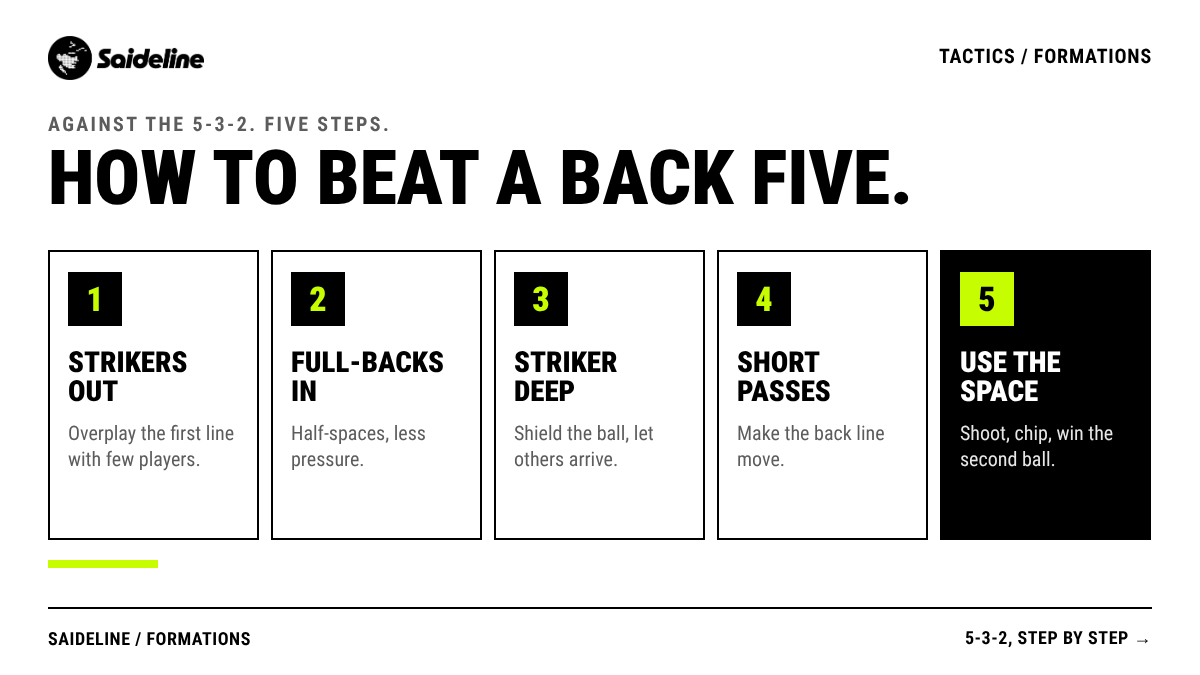
Assume realistic, good defending. These five steps follow from the strengths and weaknesses above.
- Take the two strikers out with few players. Overplay the first line with as few of your own players as possible. A defensive midfielder who drops next to the two strikers often receives the ball in an open body position, because a midfield of three cannot follow him clearly. A short moment without pressure gives him every vertical option.
- Tuck your full-backs in. The midfield three cannot cover the width, so your full-backs can move into the half-spaces. From there they receive the ball under less pressure, closer to the play and with shorter passes.
- Keep the striker deep. Against a back four, a striker who drifts between the lines pulls a center back out and leaves a gap. Against three center backs, that movement is picked up. Let the striker stay deep and shield the ball with his body. Then let a midfielder or a full-back arrive between the lines, running at the defense with an open body position. That is much harder to defend than a striker with his back to goal.
- Make the back line move. Short, flat passes force the defense to re-adjust again and again. A long switch of play gives it time to shift. Defenders are most exposed when they have to close the ball carrier at full speed.
- Use the space when the line drops. If the back five sinks to close the vertical lanes, the space in front of it opens. Dribble into it and shoot from range with teammates ready for the rebound, or chip a ball over the line for runners coming from wide. Every chip is a 50-50 ball, so place your players where it is likely to land. That is where gegenpressing and a good rest defense pay off.
The first step is also a good place to start training. A drill like the 2v1 breakout built on a disguised return pass teaches players how to beat a first line with very few passes.
Coaching points if you play it yourself
A few standard points if your own team plays with a back five:
- Agree who steps out, when, and who then covers behind him.
- Keep the distance between wing-backs and midfielders short, so the half-spaces do not open.
- Decide your pressing triggers. With few players in front of the back line, pressing without a clear trigger leaves gaps.
- Practice the switch between five and three, depending on where the wing-backs stand.
Game forms to train it
Large game forms should use a fixed formation, so that players meet the situations they will meet in a match. Small-sided games do not need one. They put players into new situations all the time and give many repetitions. Three ideas:
- Zone game, 9v9. Split the defending team into zones that match its lines, for example five defenders in one zone and the midfield in another. The defenders may not leave their zones, the attackers may move forward through them. Players find the typical answers against a back five with less pressure, but the same triggers.
- Chain-zone game, 10v10. Mark a strip in front of the goal where the back line plays 5v2 against two attackers. Narrow the passing windows with extra markers and chips become the logical answer.
- A provocation rule. Move the offside line far back into your own half. The defending team sinks automatically or gets played over, and you can help your players find solutions instead of stopping the game to criticize. Let the team in possession restart play from a fixed spot to cut set pieces out of the game.
More on how small groups and rules shape a game in small-sided games that do more. For the link between a drill and the match see drills that actually transfer to match day.
Put it into your session
A session on this topic works best when the game form comes first and the details follow. Planning a soccer practice in six steps shows one way to build that structure.
Saideline builds a session for your group from game forms made by experienced pro coaches, and the AI combines them. You can ask in your own words, for example “10v10 against a back five with a chain zone”. The library also includes 50 pro-made youth game forms from a recent update. Your first three sessions are free, with all features and without payment details: try Saideline free.
FAQ
Is the 5-3-2 the same as the 3-5-2?
They are the same shape with a different count. If you list the wing-backs with the defenders, it is a 5-3-2. If you list them with the midfielders, it is a 3-5-2. What matters in the match is how high the wing-backs stand.
Is the 5-3-2 a defensive formation?
It is built for stability, and teams in this shape tend to sit deeper because fewer players are in front of the back line. It can still attack well when the wing-backs push up and the two strikers work as a pair.
What are the weaknesses of a back five?
The back line has one player fewer in front of it. That limits pressing, and three midfielders cannot cover the full width without help from the wing-backs.
How do you beat a 5-3-2?
Take the two strikers out of the game with few players, tuck your full-backs into the half-spaces, keep your striker deep, move the back line with short passes, and use the space in front of it when it sinks. Prepare the second ball for every chip.