
Your team loses the ball in the final third. What happens in the next three seconds decides whether the opponent starts a dangerous counter or whether you already have the ball back. That is gegenpressing: not a buzzword, but a mechanism you can train, and one that sits at the core of many modern playing philosophies.
This guide explains why counter-pressing works, what a team has to do before and during the moment of loss, what comes after a successful or failed attempt, and how to build it into training.
What Is Gegenpressing?
Gegenpressing, or counter-pressing, is the immediate, coordinated attack on the ball right after your own team loses it. The goal is to win it back within seconds, before the opponent can organize.
It differs from a classic high press in one way. A high press attacks an opponent who has settled into possession. Counter-pressing attacks the moment of transition itself and tries to skip the opponent's organized possession phase altogether.
Why Gegenpressing Works
Every team that tries to create chances loses the ball again and again. Defenders sit ball-oriented, attackers are often outnumbered, and no coach can prevent every turnover. Counter-pressing starts exactly there: it keeps the opponent's time on the ball as short as possible and turns the loss into a regain.
Two benefits follow. It prevents the opponent's counter, and it lets your team attack an opponent who is still disorganized. Jürgen Klopp, the coach most associated with the idea, put the second point this way, as reported by Sky Sports and Goal: "No playmaker in the world can be as good as a good gegenpressing situation."
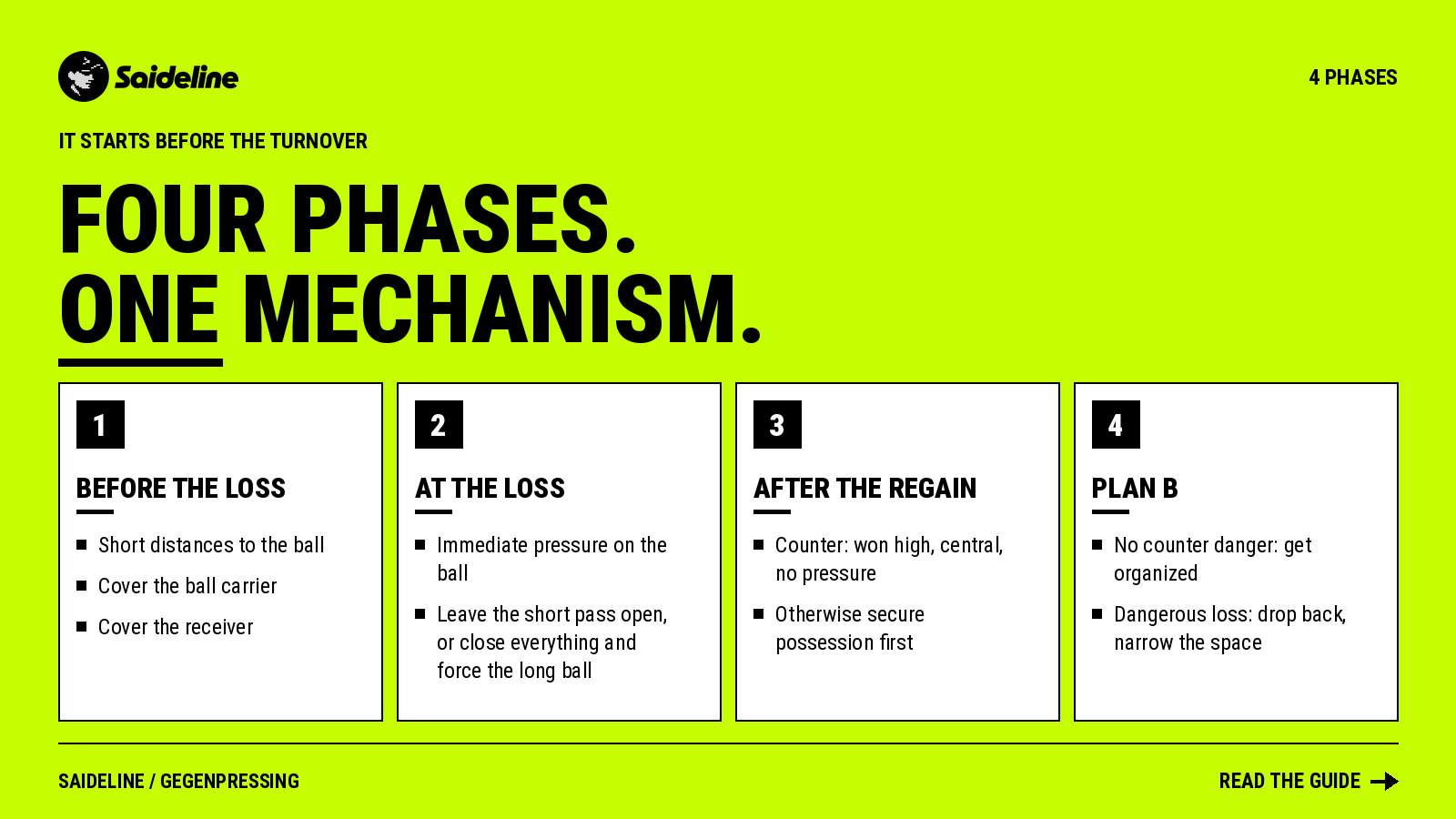
The mechanism never covers just one moment. It is easiest to coach as four connected phases: what you do in possession, what you do at the loss, what you do after a regain and what you do when it fails.
Before the Loss: Preparation Starts in Possession
A quick regain is only possible if the distances to the ball are short, and those distances have to be built while attacking. This holds across systems. A wide 4-4-2 and a 4-3-3 can both keep short distances to the ball if the positioning in attack is right.
Two group-tactical details help:
- Secure the ball carrier. A player behind and to the side of the carrier covers a passing option and can apply pressure the instant the ball is lost.
- Secure the receiver. A player who is about to receive under pressure needs the same cover, for the same reason.
One special case is the deliberate misplaced pass: the ball is played behind the opponent's back line. Both teams have to chase it, but the opponent receives it with a compact shape and immediate pressure, which favors a quick regain.
At the Loss: Pressure and Space Control
The most important part of a working counter-press is immediate pressure on the ball carrier. A carrier who cannot play a targeted pass also hides positioning mistakes elsewhere on the field.
Beside the pressure, control of the space around the ball decides success. Two opposite strategies both work:
- Leave the short pass open to win the ball. One passing option is left free on purpose, to invite a pass that can be attacked right away, with a chance at an immediate counter.
- Close everything to force the long ball. If every close option is covered, the carrier often has only a long pass, which can usually be collected safely deep in your own half.
Which one fits depends on the abilities of your players and the opponents, and on the situation.
After the Regain: Counter or Secure Possession?
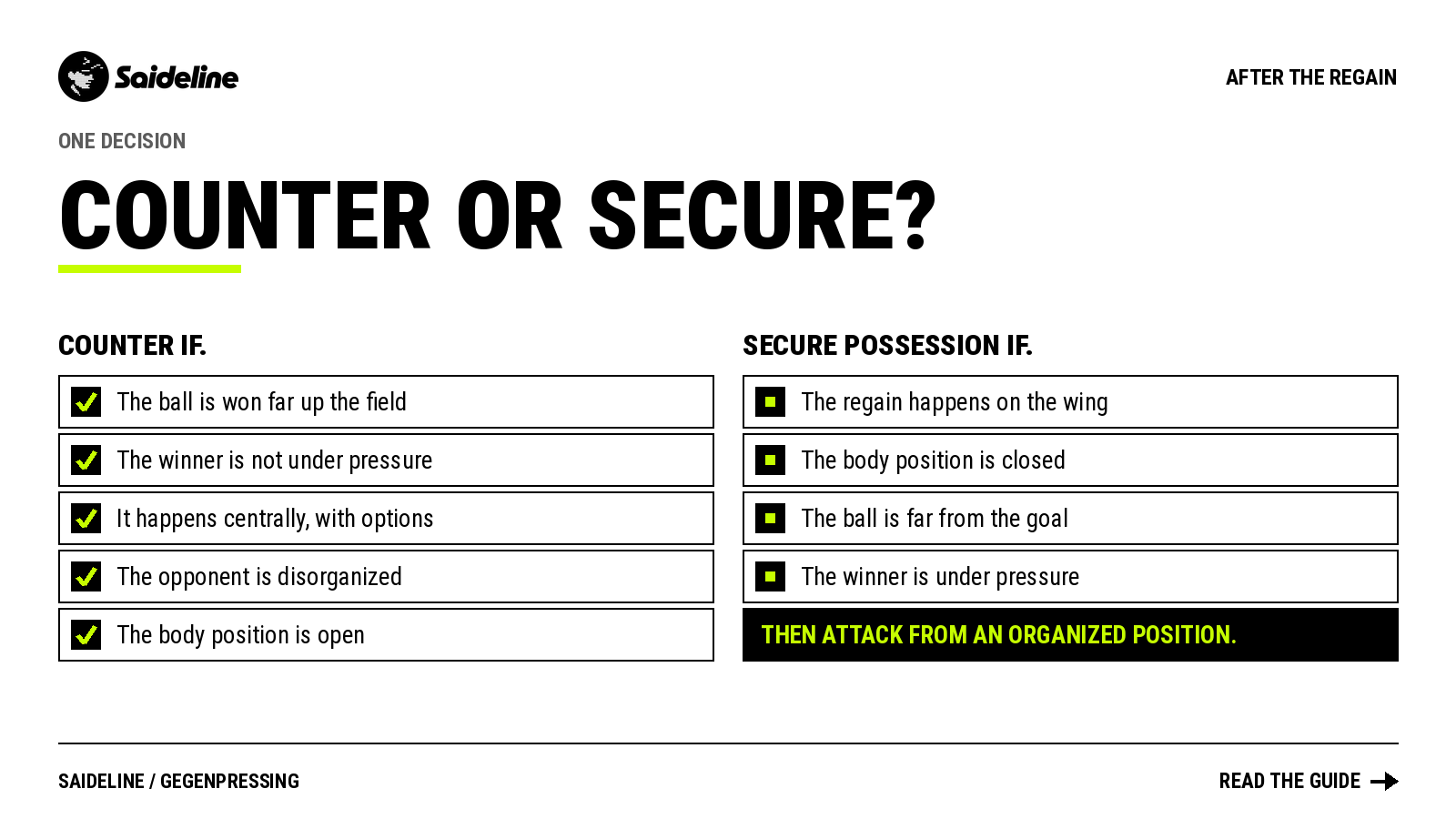
After a regain you have two choices: counter immediately or secure possession. Several criteria point toward the counter, and they reinforce each other:
- the ball is won far up the field
- the player who wins it is not under immediate pressure
- the regain happens centrally, with several passing options
- the opponent is disorganized
- the player wins it with an open body position
If these do not apply, for example after a regain on the wing, in a closed body position or far from the opponent's goal, it is usually better to secure possession first and attack from an organized position.
When It Fails: Plan B
When counter-pressing fails, the same criteria apply to the opponent in reverse. If there is no immediate danger of a counter, it is enough to get organized and drop back slightly to defend against the ball again. If the ball is lost in a dangerous position, the principles for dangerous turnovers apply: drop back toward the penalty area, narrow the space and, where possible, keep pressuring the ball carrier.
How to Train Gegenpressing
Gegenpressing is trained almost entirely in game forms, not in drills without opponents, because the turnover itself only appears in a game context. The task for the coach is to design games that provoke turnovers on purpose. These control elements work:
- Time limit for attacks. A tight window forces rushed decisions and more turnovers.
- Prescribed touches. One or two touches, or the opposite, a forced dribble, both raise the number of turnovers in different ways.
- Less space. More pressure on the space, for example on the wing or in an artificially smaller field, provokes extra losses.
- Changed numbers. Playing in numerical disadvantage creates more turnovers, but use it deliberately: pressing a player down has its own principles.
- Coaching before the loss. Freeze-style coaching works well to show, before a turnover happens, what would happen in a real situation.
- Extending the moment of loss. A rule such as "the player who wins the ball may not pass at first" makes training easier, because everyone immediately knows whom to press.
A simple starting point is a small-sided game with a time limit for attacks and the "no pass for the ball winner" rule. Add one more lever, for example a touch limit, once the group reacts quickly. For a faster, reaction-based version of the same idea, see our high-pressing games for reaction speed. And if your team is on the other side of the press, our guide on how to build up against a high press shows what opponents do to escape it.
Frequently Asked Questions About Gegenpressing
What is gegenpressing in simple terms? It is the immediate, coordinated attack on the ball directly after your own team loses it, with the aim of winning it back within seconds before the opponent can organize.
How do you train gegenpressing? In game forms, not in drills without opponents. Control elements such as a time limit, prescribed touches, less space or a "ball winner may not pass" rule provoke turnovers on purpose.
What is the difference between gegenpressing and pressing? Pressing attacks an opponent who is settled in possession. Gegenpressing applies to the moment right after your own turnover and tries to avoid the opponent's organized possession phase.
When should you counter after a regain instead of securing possession? When the ball is won high and centrally, without immediate pressure, or against a disorganized opponent. After a regain on the wing, in a closed body position or under pressure, securing possession is usually the better choice.
Conclusion
Gegenpressing does not start at the moment of loss. It starts in possession, with short distances and covered passing options. Combine immediate pressure on the ball with control of the space around it, decide quickly between counter and security after the regain, and train all of it in game forms rather than isolated drills.
If you would rather not plan these game forms by hand, Saideline builds a full session from your tactical focus: game forms created by professional coaches and combined with the help of AI. It costs €9 a month or €90 a year, and you can test it with three free sessions. See the pricing and free trial details.