
Draw eleven dots on a whiteboard in a 4-3-3 shape and you've described almost nothing about how a team actually plays. The dots don't press, don't build out, don't defend a corner kick. A formation on paper is a starting position — what a formation is for only shows up once the ball starts moving.
Think in Phases, Not Shapes
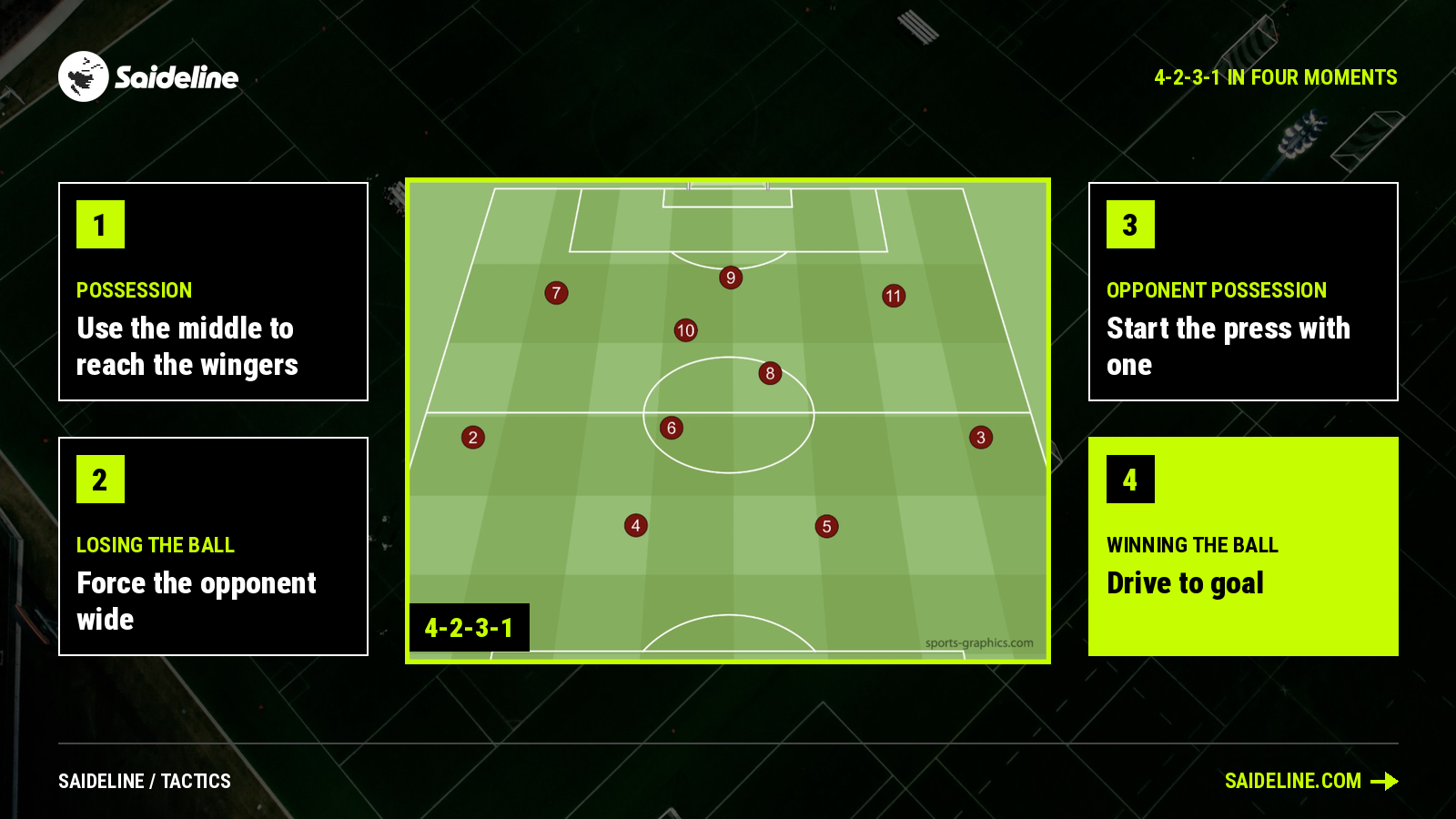
Before comparing formations, it helps to have a framework for what you're even comparing. Every team's game splits into the same handful of phases: what you do in possession, what you do without it, and what happens in the moments right after the ball changes hands in either direction (phases of play) — plus how all of that carries over into set pieces. A formation is really four or five different answers bundled under one label, one for each phase, and a good one keeps those answers from working against each other. A team built to attack extremely wide, for example, makes life harder on itself the moment it loses the ball, because winning it back quickly depends on staying compact near where possession was lost — and width and compactness pull in opposite directions.
Judge any formation by whether its phases fit together, not by how it looks lined up before kickoff.
Formations Are Families, Not Fixed Pictures
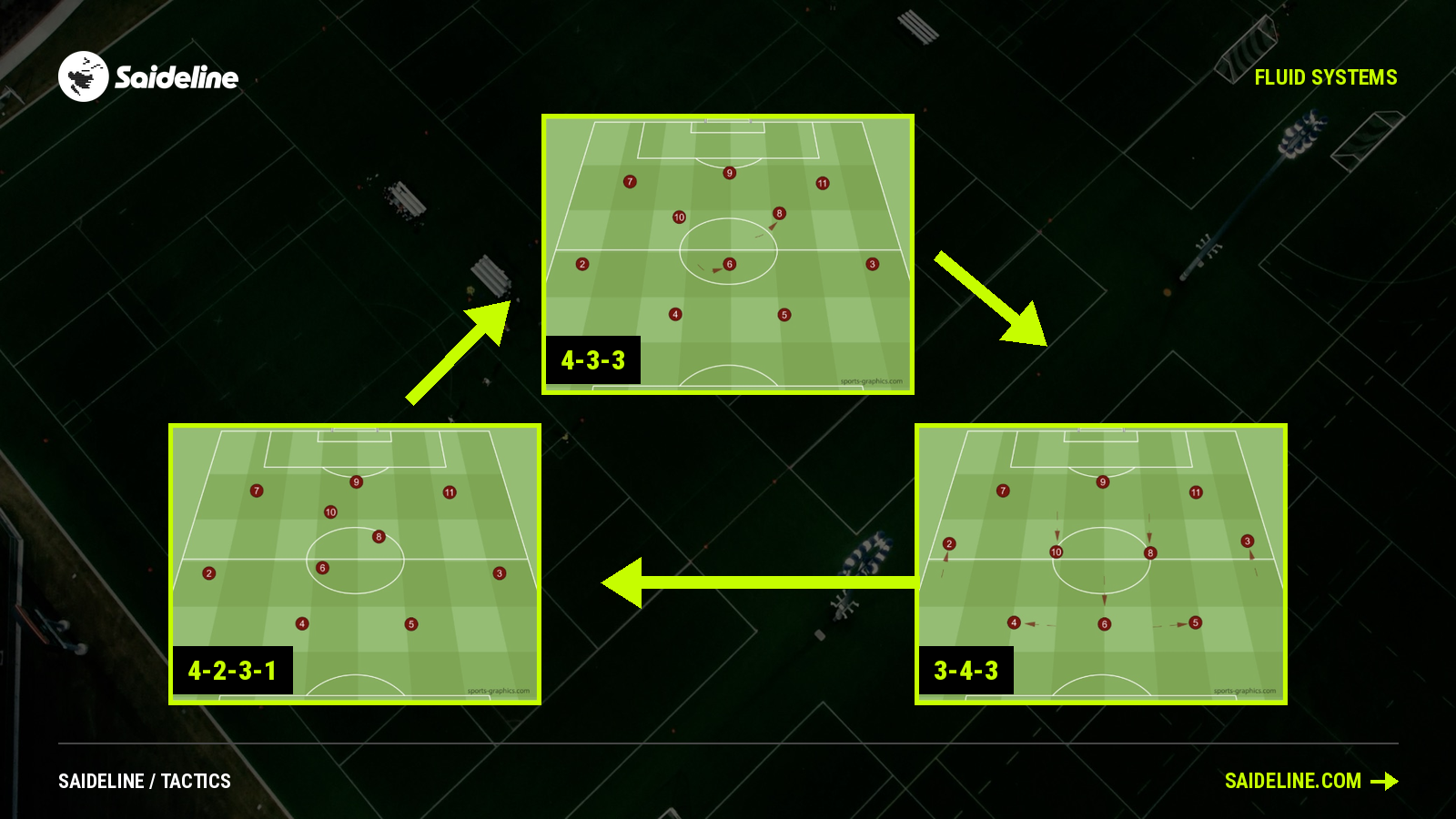
The clearest example of this is the relationship between the 4-2-3-1, the 4-3-3, and the 3-4-3. On paper they're three different systems. In practice, the same team can move between all three within a single passage of play, because the base shape and the buildup shape don't have to match. A 4-3-3 that drops its holding midfielder into the back line during buildup is playing a 3-4-3 in everything but name — the exact mechanism, including two different ways of forming that back three and what it opens up on the flanks, is worth understanding on its own terms. A 4-2-3-1 carries the same flexibility in the other direction, with its double pivot able to split into a back three just as easily.
None of this is a formation "changing." It's the same formation family expressing itself differently depending on what the moment calls for.
When a Team Removes the Target Altogether
Some tactical ideas go a step further and take away the fixed reference point defenses are built around entirely. The false 9 is the clearest version of this — a central attacker who drops into midfield on purpose, forcing an opposing center back into a decision that has no clean answer. It's not a formation by itself, but it's the kind of role that only makes sense once you understand the shape it's being deployed from, and why that shape creates the space the false 9 is designed to exploit.
The Best Way to Actually Learn a Formation
Here's the part most formation explainers skip entirely: you don't teach a formation by lining up 11 v 11 and hoping the picture sinks in. A far more effective approach is training the same relationships in a reduced-numbers game — most commonly 4 versus 4.
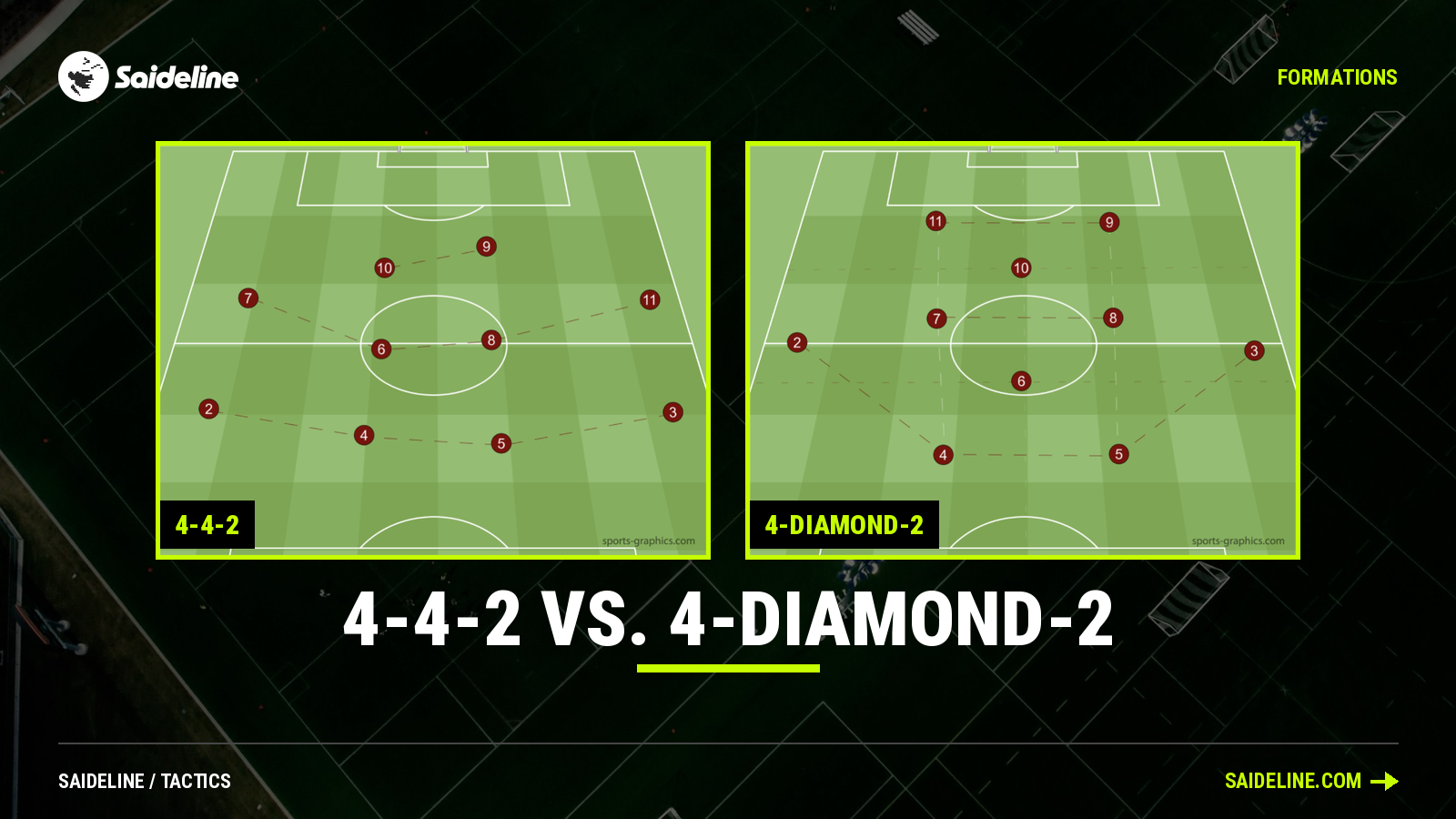
The shape you choose for that 4v4 matters more than it looks. A diamond (one back, two middle, one front) reproduces three horizontal passing lines instead of the two you'd get from a flat 2v2 — which matches how the ball actually moves up the pitch through a real back line, midfield, and front line. It also creates genuine diagonal passing angles that a flat two-line shape simply can't offer, since a flat shape only allows the ball to travel sideways between two players with no forward option.
You can sharpen the picture further by adding target players — a neutral player near a goal who can only lay the ball off with one touch teaches the exact demands of playing with your back to goal, while a neutral central player who's allowed two or three touches starts to behave like a genuine central midfielder. Change the restriction, and you change which real position the drill is quietly training.
Handled well, a 4v4 diamond isn't a simplified warm-up game — it's a working model of 11v11, small enough to coach every touch and every decision, but built from the same lines and angles the full-size game actually runs on.
Where to Start
Don't start by picking a formation off a list. Start by deciding what you want each phase of the game to look like, choose a base shape whose natural flexibility supports that — most of the popular systems already flex between two or three related shapes — and then teach the underlying relationships in a reduced game before you ever expect them to show up at full size.