
Most coaches plan a session by picking a drill. A better starting point is the game itself. Every match is made of recurring situations, and each one asks for its own behavior. Those situations are the phases of play. Once you can name them, you can see where your team is missing something and which training form fixes it.
This guide covers the five phases of play in soccer, why they must fit together, how to turn a phase into a short coaching rule, and how to build a training week around them.
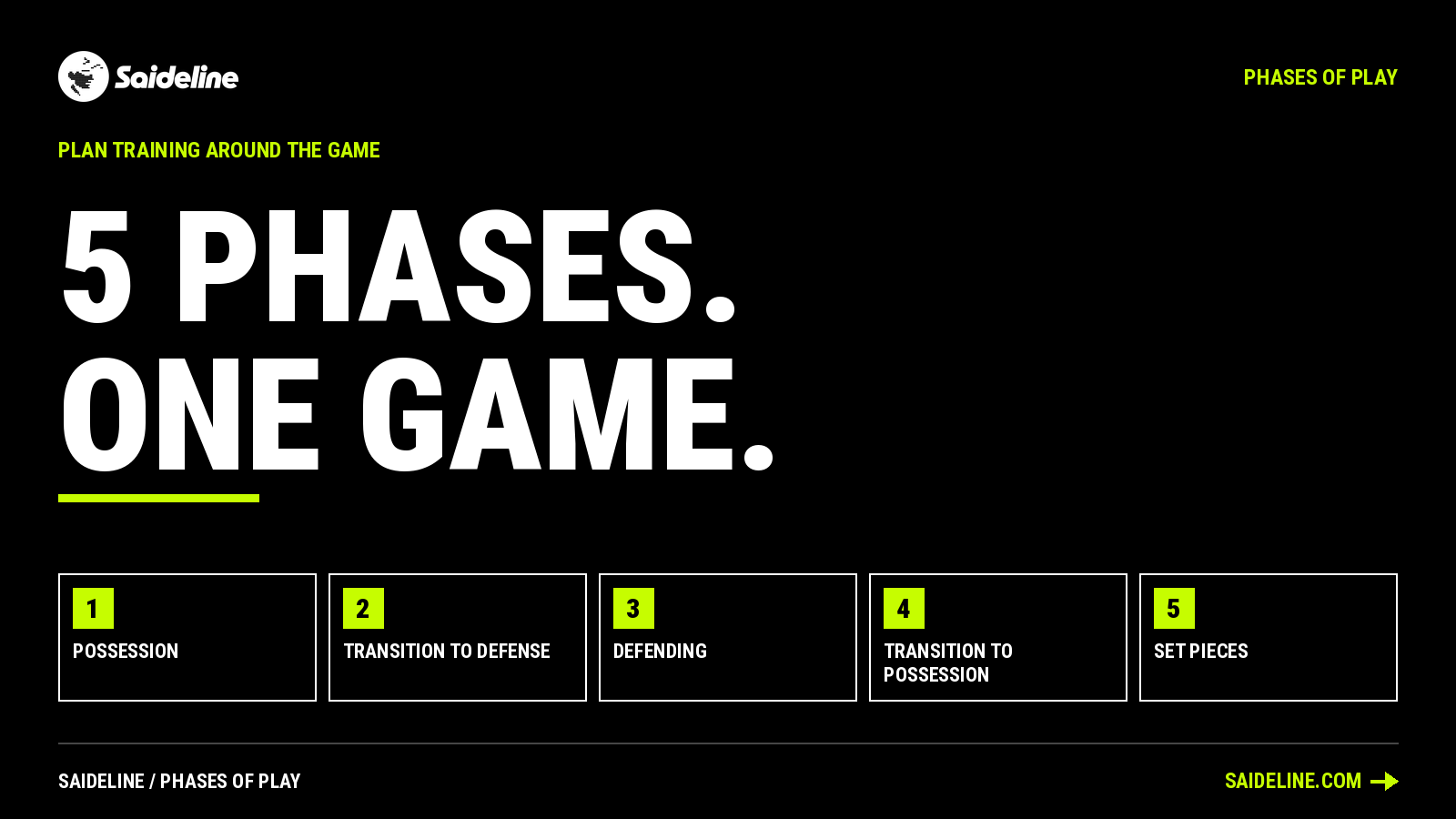
The Five Phases of Play
1. Possession. All situations in which your team plays against an organized opponent: build-up, combination play and finishing.
2. Transition to defense. When the ball is lost, a team is mostly disorganized. This phase decides whether you win the ball back immediately or the opponent gets time to organize. The full picture is in our guide to counter-pressing.
3. Defending against possession. Once your team has reorganized, it defends against the opponent's possession, for example with a high press or a mid-block. Our article on high pressing shows how that can be trained.
4. Transition to possession. After winning the ball, the team chooses between keeping possession and a direct counter. An opponent who is still disorganized is the best reason to counter.
5. Set pieces. They follow the same four distinctions. Even your own corner needs an answer to one question: how do we switch to defense if we lose the ball?
The phases are not a rigid chain. A direct switch from one transition to the other is possible, for example when a regain is followed by an immediate loss. Together, the five phases cover the whole game. A simple first step is to draw them as a diagram and fill in your own ideas for each one.
Make the Phases Fit Together
Your ideas for possession, defending and both transitions should not contradict one another. A common example is playing very wide in possession to create switches of play. That makes it hard to counter-press after a loss, because counter-pressing needs short distances to the place where the ball is lost, and a team spread across the full width often cannot create them.
When you plan, check each phase against the next. If a principle in one phase makes another phase impossible, change one of them. The same logic applies to your base shape. Our guide to soccer formations shows how the same shape can behave differently across the phases.
From Phase to Coaching Rule
Once you know what you want in each phase, turn it into a short coaching rule. The "if..., then..." form works well:
- "If the opponent presses high, then play a long ball regularly." (possession against a high press)
- "If you have space in front of you, then dribble at tempo." (possession, creating a 2v1 by dribbling)
- "If you win the ball, then think, dribble and play forward." (transition to possession)
Instructions and prohibitions work too, such as "Never dribble sideways!" or "One presses, one covers!" Rules like these can apply to the whole team, a group or a single position.
Keep them helpful, not rigid. Players should know that a rule is a good idea in most situations, not all of them. Add a clear trigger for each rule, and put the most important ones where players see them, for example on a poster in the changing room. Over time the team builds a shared language, and you can explain a complex situation with one short sentence.
Plan the Training Week Around the Phases
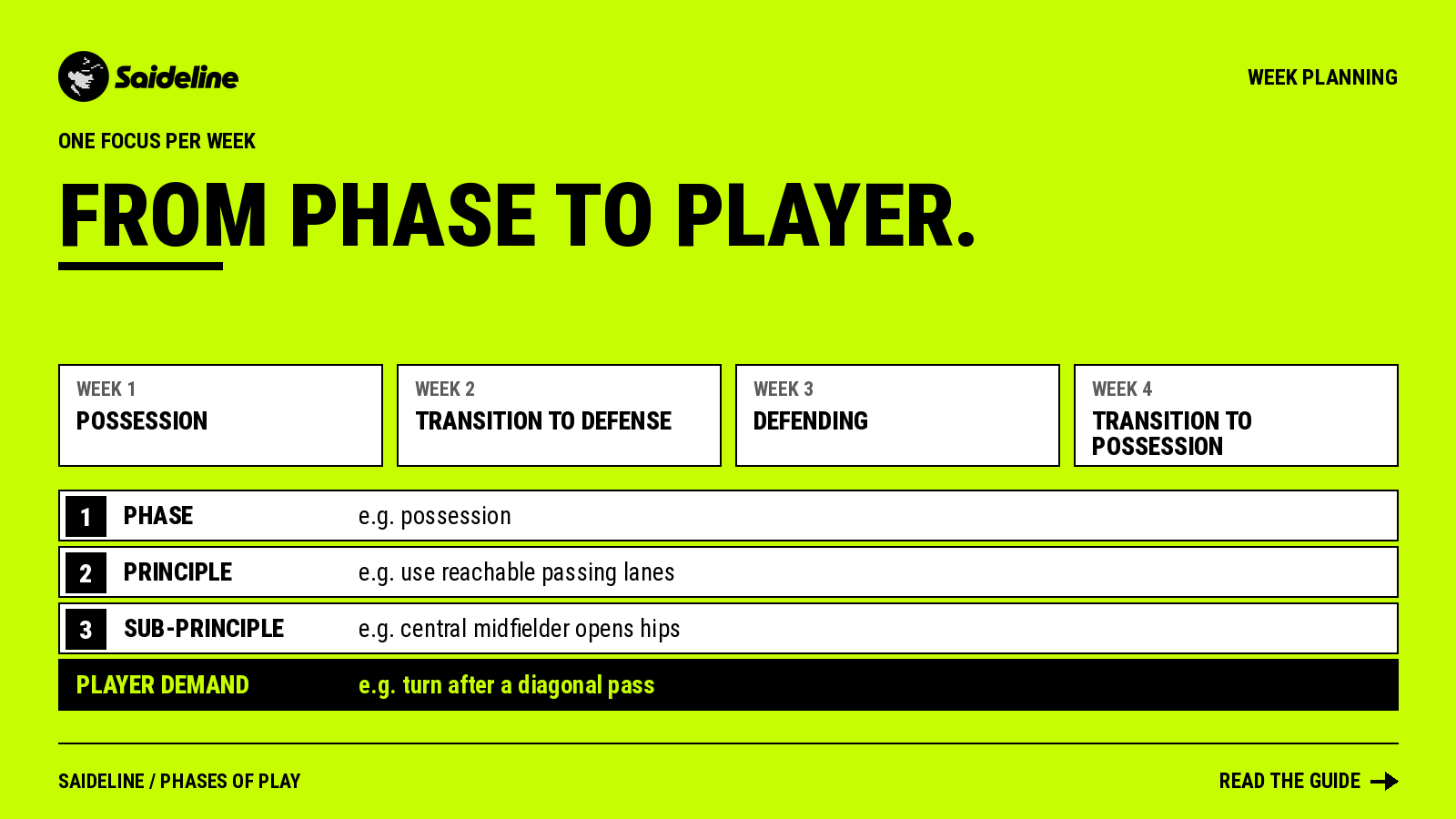
The phases also give a training week a frame. One way to set it up is to let each week focus on one phase and rotate through the cycle:
- Week 1: possession
- Week 2: transition to defense
- Week 3: defending against possession
- Week 4: transition to possession
Within the week, the game forms are built mainly around that phase and linked to your overall principles. Toward the end of the week, the forms move step by step into the next phase, so the transitions are trained too. This frame helps you keep a core topic from being pushed out by short-term demands, and it stops you from over-emphasizing one topic.
Inside that frame, break the idea down from the general to the specific:
- Phase: for example, possession.
- Principle: for example, move the ball through reachable passing lanes.
- Position-specific sub-principle: for a central midfielder, be available between opponents and receive with the hips open toward the direction of play.
- Demand on the player: turn with the ball after a slightly diagonal pass into space.
The long-term plan decides which topics must come back regularly. It does not fix every detail of a single session, and you decide that day by day.
Two Levels: Planning and Communication
Keep two levels apart. The planning level is for you as the coach: detailed and long term. The communication level is what players hear. It stays simple and always leads back to the same principles, whether it is a coaching point in a drill, a video clip or individual feedback. Your planning can be complex as long as what reaches the player is clear and fits his current task.
Show the Phases in Training
For each phase you can choose a fitting form. The basic choice is between drills and game forms.
Drills run without opponents. They allow many repetitions of a single skill, and you can make them closer to the game with time pressure, passive opponents, competition between two groups or extra perception tasks.
Game forms combine all aspects of a match: technique, tactics, fitness and mentality. They range from small-sided games (1v1 to 4v4) through large-sided games (5v5 plus goalkeepers) to match simulations. When you introduce a new coaching rule, link it to a small-sided game first and vary it afterward. For ideas, see our 1v1 soccer drills.
Rules can steer the transitions. In an 8v8 on a field split into four squares, the team that wins the ball must play it into a different square immediately. In possession, the team already has to be positioned to stop counters, ideally with one player securing every ball carrier from a slightly offset position.
Every game form is also a test. You create situations, change the demands, coach the behavior you want and watch how players solve the problem. That tells you what is already stable. End each session with a game that is as open as possible, even if it is only two short periods on a smaller field. It shows which principles survive when you give less guidance.
Use the Phases to Analyze an Opponent
The five phases also work for scouting. How does the next opponent build up, defend, switch and handle set pieces? With those answers you can set up a match simulation: a sparring team plays the opponent's style while a coaching team looks for solutions. If players are missing, zones, goals or lines can stand in for the missing positions.
Conclusion
If you know the phases of play, you stop planning by accident and start planning from the game. First the phase, then your idea, then a short coaching rule, and finally the training form. The result is a session in which every drill has a clear place in the match.
If you would rather not build these forms by hand, Saideline creates a full session from your tactical focus. The game forms come from professional coaches and are combined with the help of AI. It costs €9 a month or €90 a year, with three free sessions to test it. Try it at saideline.com.