
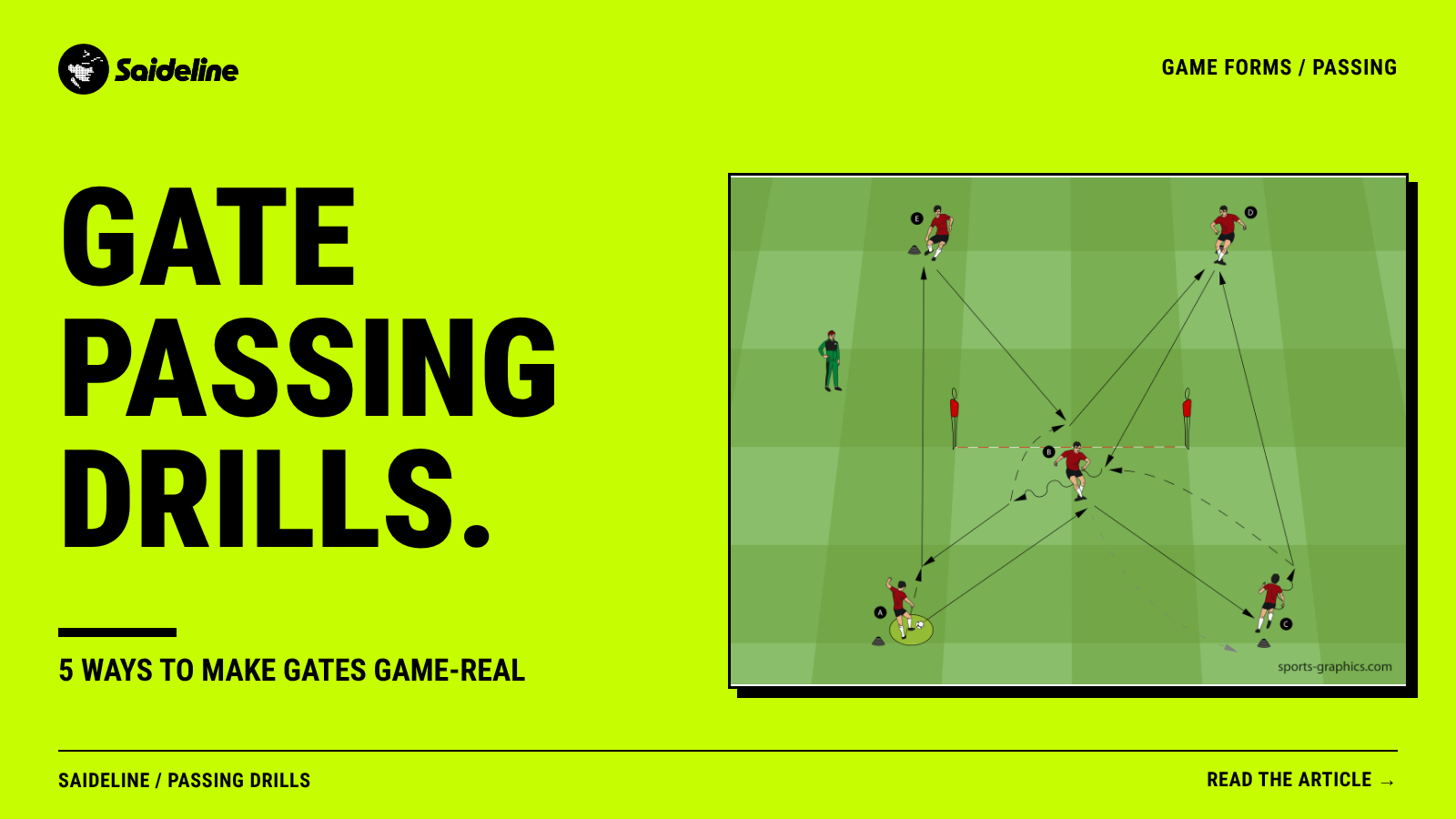
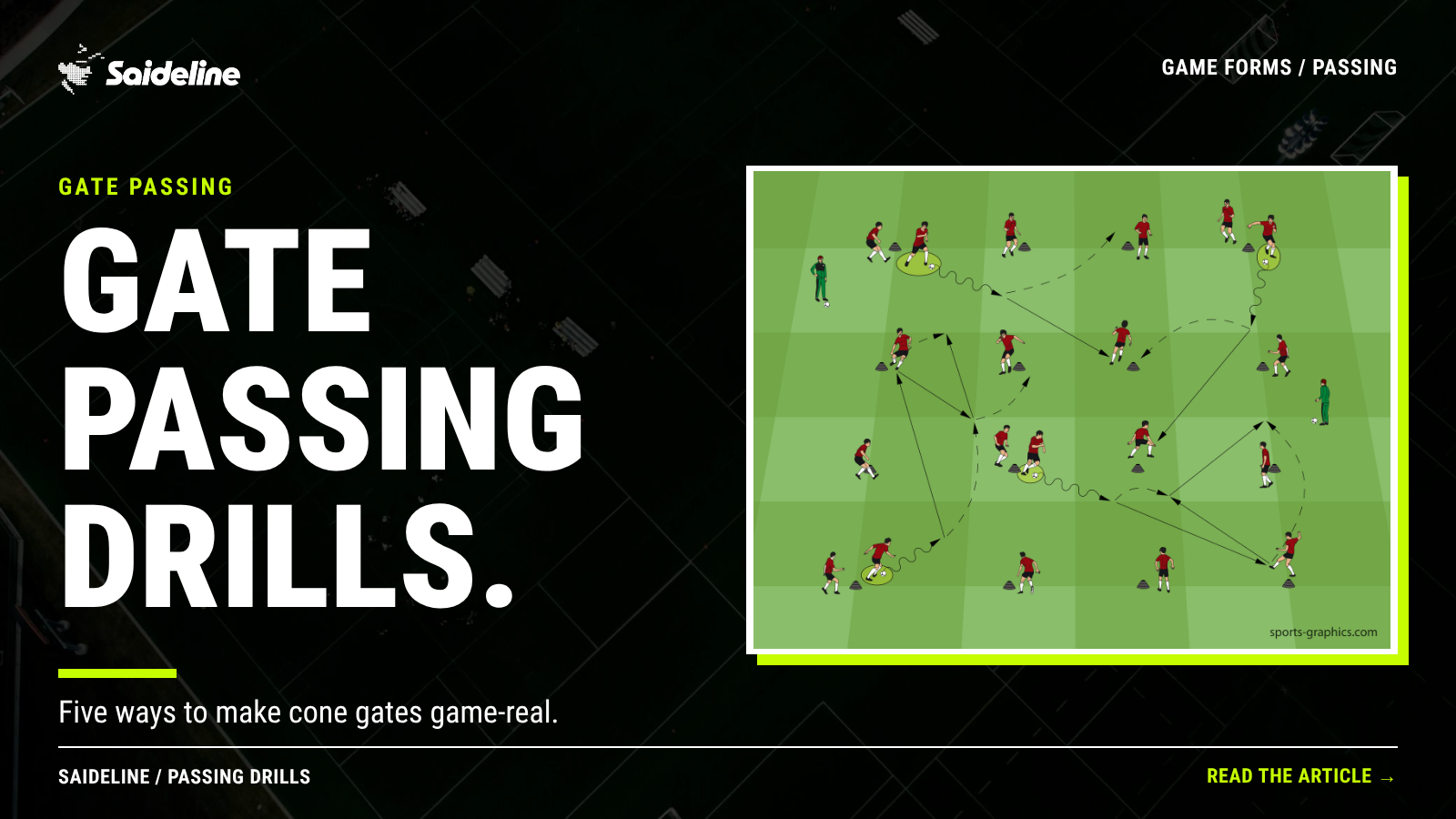
Gate passing drills are among the first exercises most coaches set up: two cones, a ball, a pass through the gap. It trains the accuracy and weight of a pass, and it takes two minutes to organize. It also has a limit. Nobody defends the gate, nothing changes from one pass to the next, and no player has to decide anything. This article keeps the simplicity of cone gates and adds match demands one step at a time, from a pass on the move to a 4v4 where pass gates come before the big goal.
What gate passing trains, and where it stops
A gate is two cones with a gap between them. The ball has to travel through the gap along the ground. That is useful for passing accuracy, for the weight of the pass, for the first touch of the receiver, and for body position when the ball arrives.
What a fixed gate cannot do is behave like a passing lane. In a match, a lane opens and closes with the position of the opponent, and the player has to read that. The passing warm-up that turns a 1v1 into a 2v1 shows how an opponent changes a passing drill, and drills that actually transfer to match day explains why that matters. The five steps below add one thing at a time: movement, an opponent, a purpose, a choice.
1. Gate passing on the move
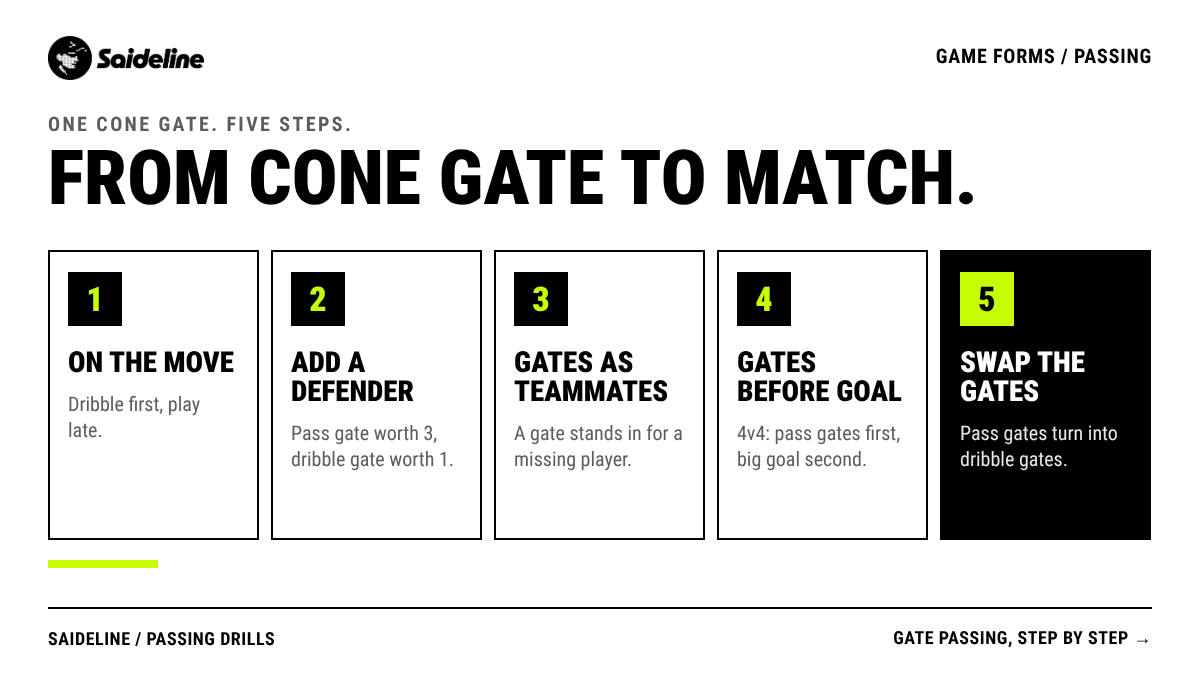
Start with the basic form, but build match habits into it. The passer does not pass from a standing position. He dribbles toward the gate first and plays the ball late, so the receiver is not put under pressure the moment the ball leaves his foot. The receiver does not check toward the ball. He peels off to the side and opens the lane only after the dribble has started: first dribble, then open the lane.
Coaching points for this step:
- Play the pass as hard as possible and as soft as necessary. It needs the pace of a match, but the receiver must still be able to control it.
- Aim for the foot away from the gate, or slightly into the run when the receiver has space ahead.
- The receiver stands half open, takes the ball with the far foot and passes with the next step.
- Avoid flat square passes. A slight angle keeps the next action open and reduces the risk of losing the ball.
- Keep moving after the pass. Play, then go.
2. Add a defender: pass gate and dribble gate
Now give the gate an opponent. Set up a small 1v1 with two gates: a pass gate and a dribble gate. The attacker scores by playing the ball through the pass gate or by dribbling through the dribble gate. The defender has to cover the pass gate first and steer the attacker toward the dribble gate. That buys him time to win the ball.
A simple scoring rule sharpens the picture. A goal through the pass gate counts three, a goal through the dribble gate counts one. The attacker now has a reason to fake, change pace and look for the pass, and the defender has a reason to protect the more dangerous option. If the defender wins the ball, a quick counter is allowed, but nothing more. More on duels in 1v1 soccer drills, and for an opponent-based breakout see the 2v1 drill built on a disguised return pass.
A useful side effect: with a pass gate behind him, the defender has to keep looking over his shoulder. Sooner or later he has to anticipate where the pass is going, step in and counter.
3. Let gates stand in for missing teammates
You rarely have 22 players. Gates can fill the gaps. Draw the situation you want to train as a full 11v11, as detailed as you can and at the height of the pitch where it happens. Then cut out the players you do not have and put a pass gate where each of them would receive the ball.
Place each gate the way a teammate would stand in a match. A receiver in the final third is reached by a vertical pass. A receiver between the lines is reached at an angle, so the gate has to sit at the angle that is realistic in the game, not simply in front of the passer. The idea is close to the one behind game-realistic training without the real location: keep the demands of the match even when the setting is simplified.
4. Pass gates before the big goal
This is a 4v4 competition form. Mark six pass gates on the pitch, in different colors. A team may only score on a big goal after it has scored through a pass gate of each color. The goals are only the second target, so at first there is no fixed direction. The game feels like a possession game.
That changes what the players have to do. Because play can continue in many directions, the player on the ball has to keep it, often by dribbling, and everybody around him has to keep finding new angles and open lanes. For more on how small groups and small pitches shape a game, see small-sided games that do more.
To raise the demand, give each team a secret game plan with the order in which the gates have to be played. A plan stays in use until the team scores. Then the coach hands over a new one.
5. Turn pass gates into dribble gates
The last step is a switch. On the coach’s call, pass gates turn into dribble gates, or the other way round. The players have to recognize at once which option the situation now offers: a pass through the gate, or a dribble through it. It also helps the defender, who has to adjust his position to the new target and cannot rely on a single plan.
You can use the same switch in the 1v1 from step 2 or in a 4v4. Keep the rule simple and change it rarely, so that the players have time to react to it.
Coaching points that keep gate passing honest
- Check what the gate is meant to stand for. A pass gate should represent a teammate, a lane or a target, not just a gap between two cones.
- Look before the ball arrives. The receiver orients while the ball is on its way, not after the first touch.
- Count decisions, not only completed passes. A drill with a hundred clean passes and no decisions is a technical session.
- Move gates and change tasks often, so that players do not learn the drill instead of the game.
Build gate passing into your session
Gate passing fits at the start of a session, as a technical lead-in, and again as the competition at the end. A session that moves from a simple gate to a game with a defender and a purpose follows the same idea as planning a soccer practice in six steps: one theme, rising complexity, and a game at the end.
Saideline builds your session from game forms made by experienced pro coaches. The AI combines them into a session for your group, and you can describe your idea in your own words in the prompt, for example “passing game with pass gates for eight players”. You can try it with three free sessions, with all features and without payment details: try Saideline free.
FAQ
What is gate passing in soccer?
Gate passing means passing the ball along the ground through a gap between two cones to a teammate. It trains the accuracy and pace of a pass and the first touch of the receiver. Without an opponent it is a technical drill. With a defender, a purpose or a choice it becomes much closer to a match.
How wide should the gates be?
There is no fixed width. Start wide enough for the group to succeed and narrow the gap as the quality of the passes improves. With a defender the position of the gate matters more than its width, because it decides which option the defender has to cover first.
How do I make gate passing more game-realistic?
Add one thing at a time. Let the passer dribble first and pass late, add a defender, let gates stand in for teammates, and give the gates a purpose, such as pass gates before the big goal in a 4v4.
Can I use gate passing with few players?
Yes. Pairs and small groups work well, especially with a defender and a pass gate and a dribble gate. For more ideas see what a smart coach does with only four players.