
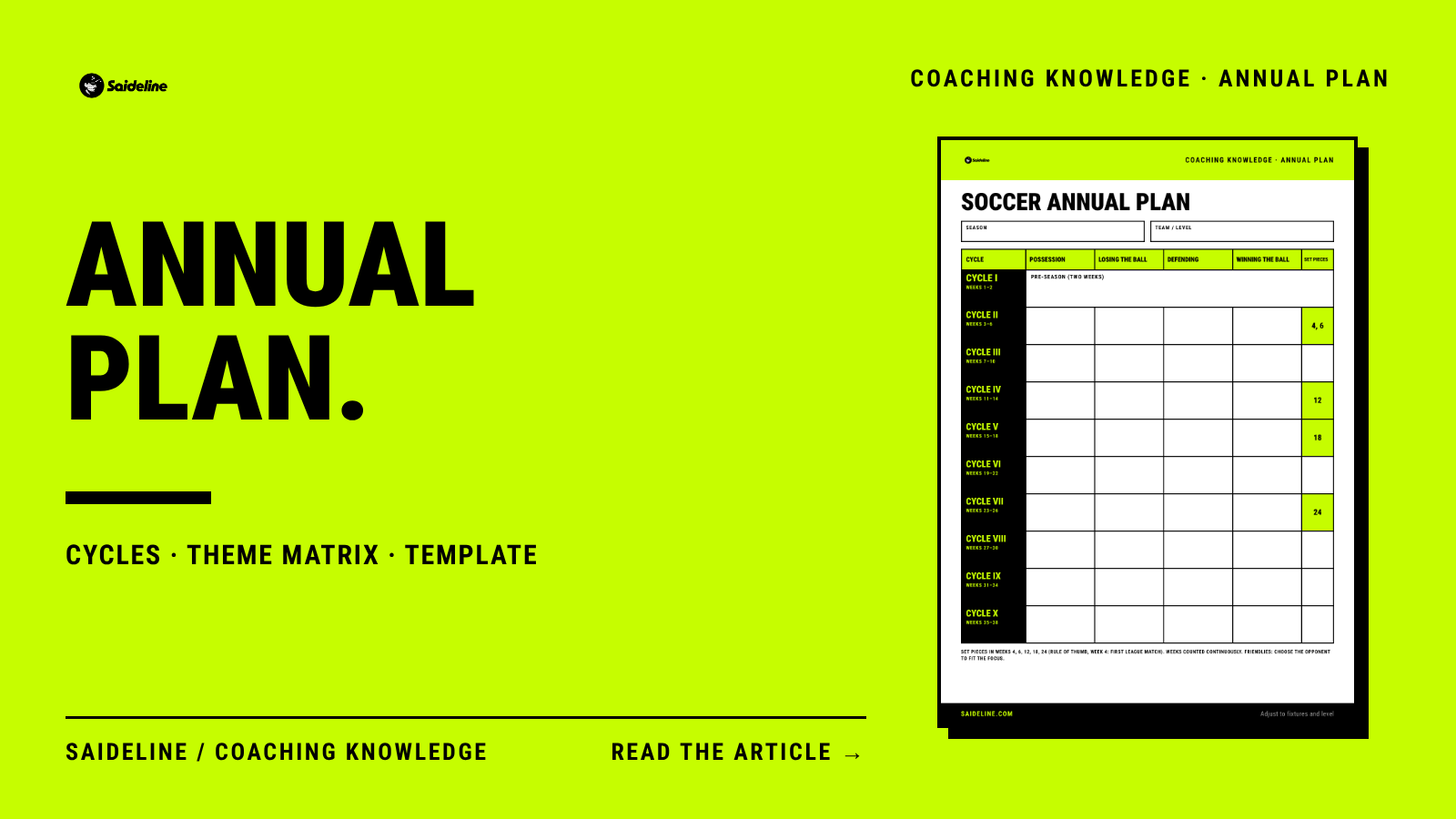
A soccer annual training plan does not answer what you train on Tuesday. It answers why you train it and when it comes back. Without a plan, one theme drops out because something else feels more urgent, and another gets practiced for the tenth time. This article shows how to build the training year as a cycle of cycles: a short pre-season, regular four-week blocks, a theme matrix and a fixed rhythm for set pieces. At the end you can save an annual plan template.
The training year as a cycle of cycles
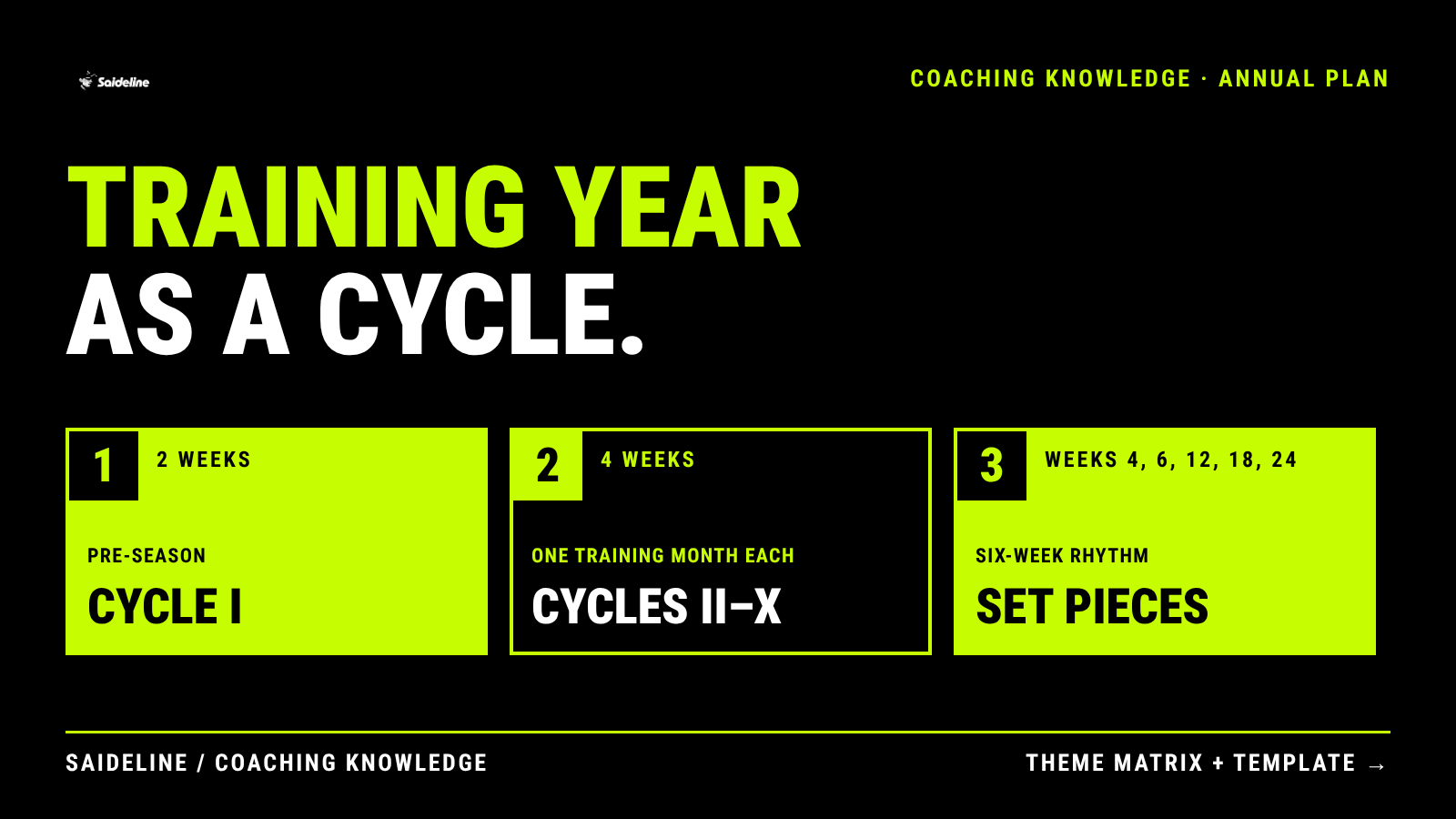
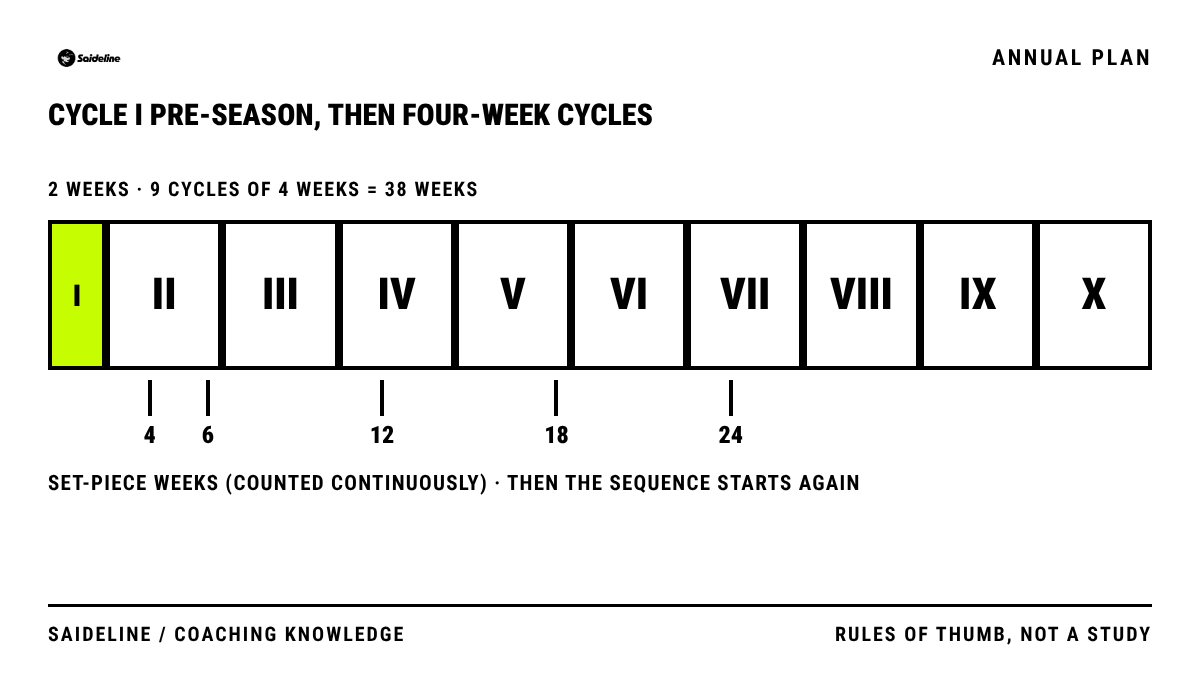
The basic idea: the year consists of cycles, and every cycle follows the same pattern.
- Cycle I is the pre-season and lasts two weeks. (For a pre-season built only on game forms, see Soccer Pre-Season Plan: Example Using Only Game Forms.)
- Cycles II to X last four weeks each. Each one is a training month built on the four phases of the game, as described in Soccer Monthly Training Plan: 4 Weeks, 4 Phases.
- Then the sequence starts again. The year repeats as a loop.
By this count that is 2 weeks of pre-season plus 9 cycles of 4 weeks, so 38 weeks. How many weeks your year really has depends on the summer break, the winter break and weeks without matches. The phases everything builds on are explained in Phases of Play in Soccer: Plan Training Around the Game.
The theme matrix: phases and cycles
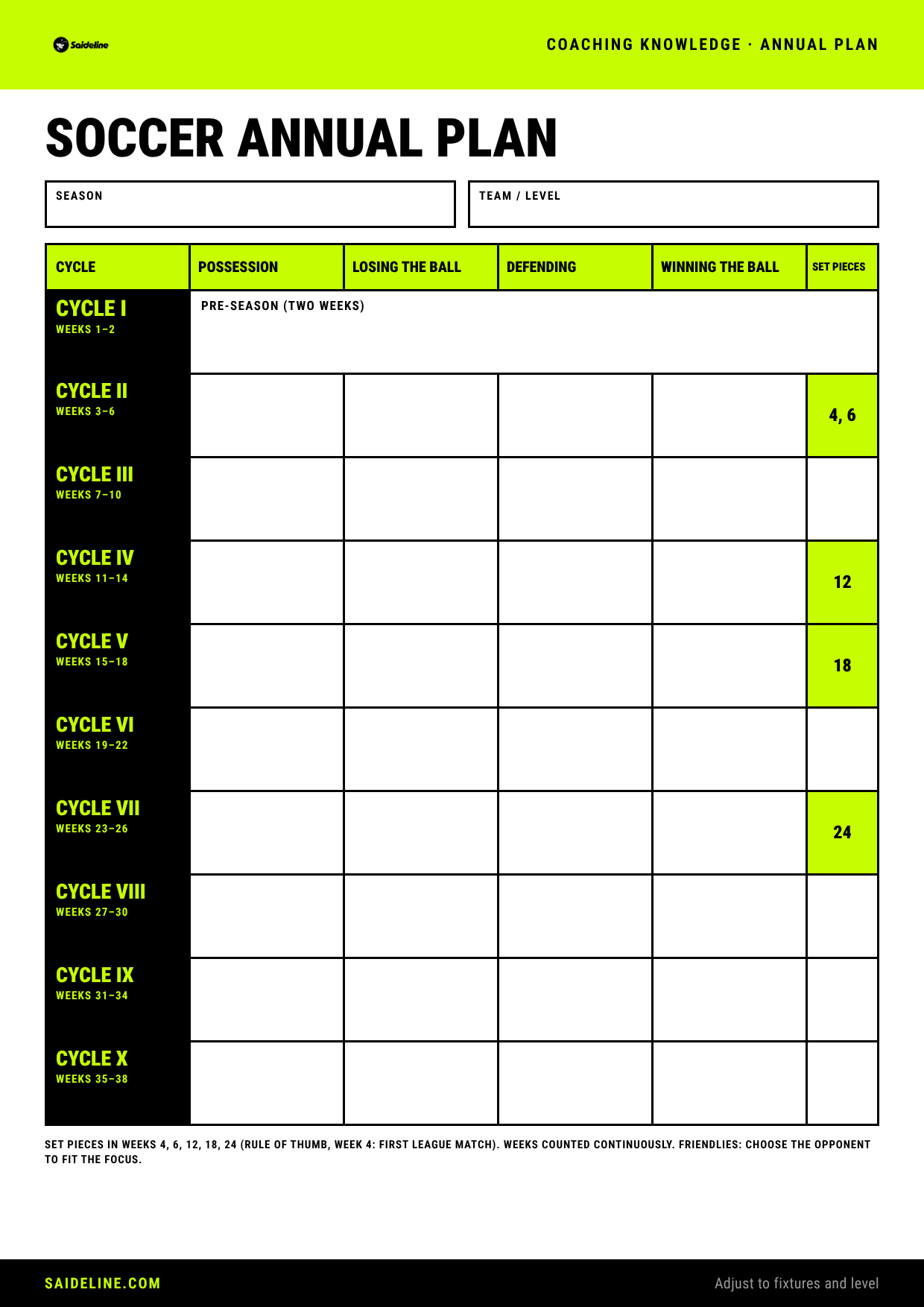
The core of annual planning is a matrix. One axis is the four phases of the game, the other is the cycles. You enter one theme in each cell. That shows at a glance which themes appear in which month. Good example themes for each phase:
- Possession: playing against a blocked remaining field, resistance to pressure, build-up with a numerical advantage, working chances out of build-up, playing against a deep back four or back five, finishing attacks around the box.
- Losing the ball: counter-pressing in several levels, from I to IV.
- Defending against the ball: pressing in the defensive half, high pressing with equal numbers and a numerical disadvantage.
You can treat each phase like a theme series: every cycle takes the next theme in the series, and after the last level it starts again at a higher standard. For depth on single themes, see Build-Up Play Against a High Press: A 2v1-into-2v2 Drill, Gegenpressing Explained: Counter-Pressing in Soccer and High Pressing Games That Train Reaction Speed, Not Fitness. The themes are examples: choose by the level and age group of your team.
Set pieces on a six-week rhythm
Set pieces cut across the phases, so they get their own beat: roughly every six weeks. As a practical figure, set pieces go in weeks 4, 6, 12, 18 and 24. Week 4 is a special case because the first league match is due then. This is a rule of thumb from experience, not a study. You can adjust it to your fixture list.
Friendlies: choose the opponent to fit
Friendlies are part of the plan. Choose the opponent to fit the focus of the week, and adapt the weekly theme to the opponent where it makes sense. How to build a week around one focus is shown in Soccer Training Week: Weekly Plan Around One Focus.
Plan variety and recovery
An annual plan may also include breaks from the usual training. Alternative activities, for example another sport or a different kind of session, bring variety and help recovery. Plan them as fixed items instead of allowing them only when the calendar forces it.
An annual plan in five steps
- Clarify the framework: when does pre-season start, when are the summer and winter breaks, which weeks have no matches?
- Enter the cycles: cycle I with two weeks, then cycles of four weeks each.
- Distribute the themes: write one theme per phase and cycle into the matrix.
- Mark the set pieces: reserve the weeks on the six-week rhythm.
- Add friendlies and variety: choose opponents to fit the focus and plan alternative activities.
Annual plan template to save
The template holds the year on one page: cycle I as pre-season, cycles II to X with the four phases of the game as columns, and the set-piece weeks. Weeks are counted continuously, and weeks 4, 6, 12, 18 and 24 are marked. Tap or click the image and save it, to print it or fill it in digitally.
Planning the year in Saideline
In the Saideline calendar you enter sessions and matches and switch between week, month and season view. You set the weekly theme yourself, for example counter-press or mid block, and choose the load for each session: Low, Medium or High. Saideline builds the sessions themselves from coach-made game forms. The calendar is open to all users, including during the three free sessions. How the calendar works is explained in Soccer Training Calendar: Plan Weeks, Load and Sessions, and the basics of planning a single session are in How to Plan a Soccer Practice: 6 Steps for Coaches.
Frequently asked questions about the soccer annual training plan
How do I build an annual training plan in soccer?
Split the year into cycles: two weeks of pre-season, then cycles of four weeks with the four phases of the game. Enter one theme per phase and cycle into a matrix and mark the set-piece weeks.
How long is a cycle in the training year?
Cycle I, the pre-season, lasts two weeks. Cycles II to X last four weeks each and correspond to one training month.
When do I train set pieces?
As a rule of thumb on a six-week rhythm, so in weeks 4, 6, 12, 18 and 24. Week 4 is a special case because of the first league match.
Do I have to stick to the plan strictly?
No. The plan is a frame. Fixtures, opponents and squad change, and the weekly themes can be adapted to the next opponent.
Conclusion
A training year needs structure and repetition: a short pre-season, cycles built on the four phases, a matrix that distributes the themes and a fixed beat for set pieces. Once the frame is built, every week costs less planning. Take the template, enter your team's themes and adjust it during the year.