
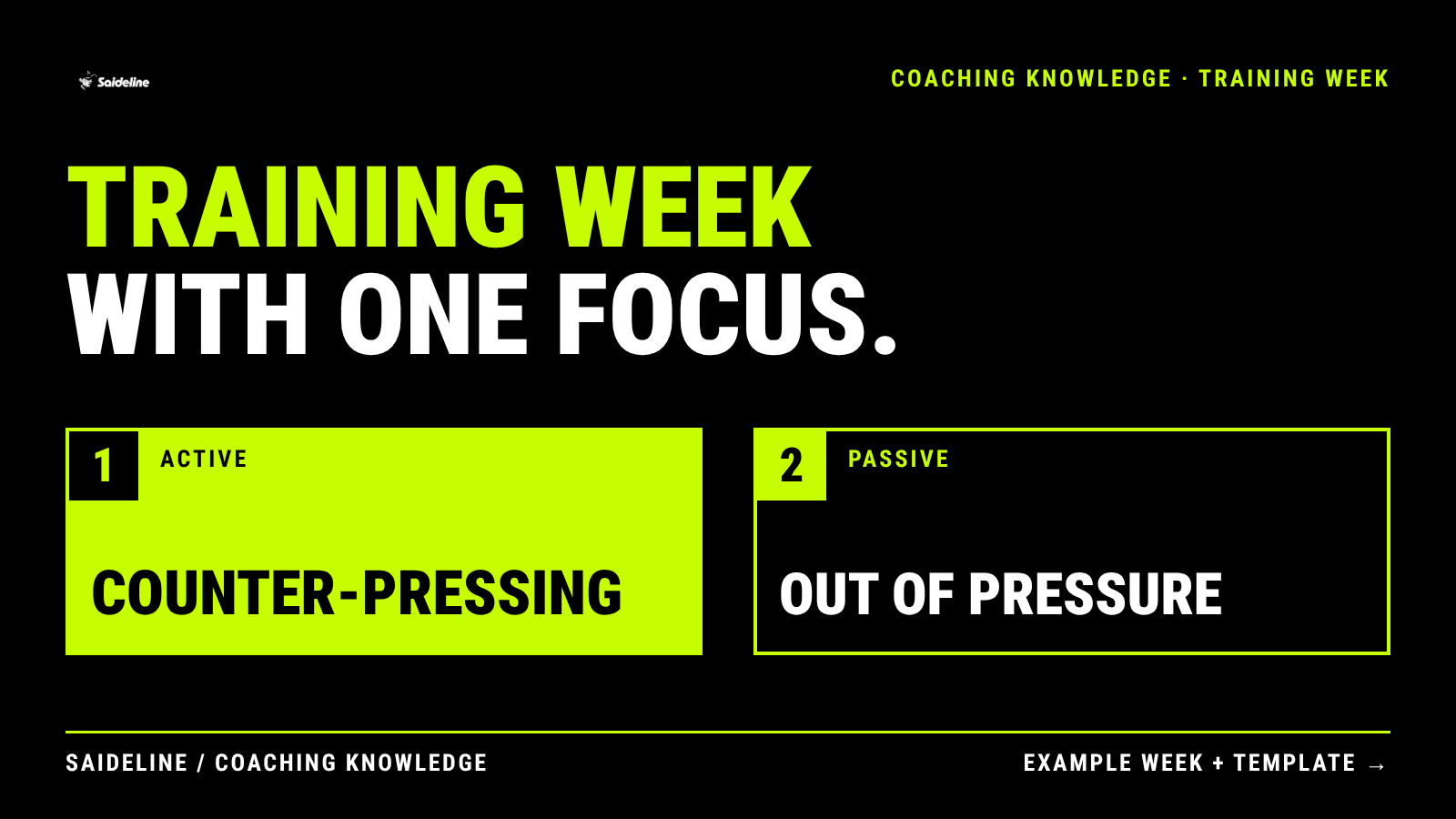
A good soccer training week has one theme that runs from the first session to the last. If you plan every session on its own, you jump from pressing to passing to finishing and wonder on Friday what actually stuck with your players. This article shows how to build a weekly training plan around one focus, how your coaching changes between the start and the end of the week, and what an example week on counter-pressing looks like. At the end you can save a weekly plan template.
One focus per week: active and passive
Each week you pick one focus, the active focus. It belongs to one of the four phases of the game: possession, losing the ball, defending against the ball, or winning the ball. How to use the phases in your planning is covered in Phases of Play in Soccer: Plan Training Around the Game.
Every active focus has a counterpart, the passive focus. This is the side that plays against the active focus. If the team learns counter-pressing this week (active), it also practices getting out of pressure (passive). That fits pressing games well: without a team that wants to break free, the press has no real opponent. For the active side, see Gegenpressing Explained: Counter-Pressing in Soccer. For the passive side, Build-Up Play Against a High Press shows a drill in which the team under pressure has a real task.
A focus does not mean everything else disappears. It decides what you coach when several things happen at once. That makes your feedback clearer and helps players recognize the theme.
Start of the week: give the picture, coach with stops
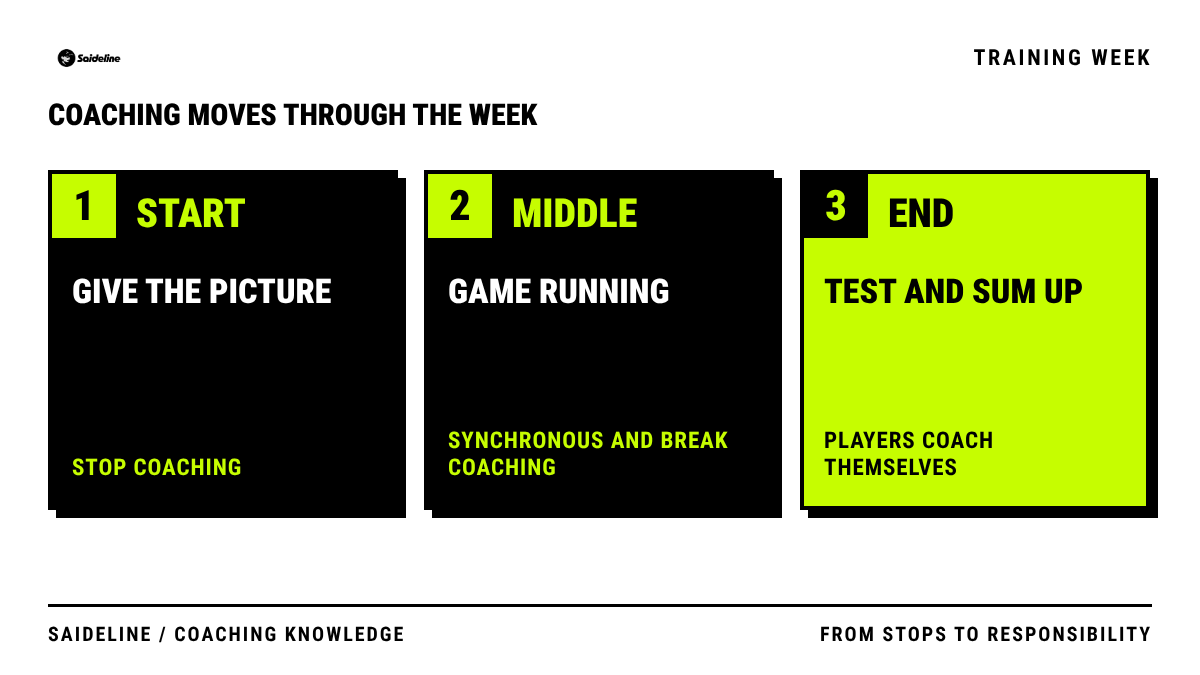
At the start of the week players do not know the theme yet. So the rule is: picture first, details second. Show the theme in one drill or a short video, then move into game forms. As a rule of thumb from practice, keep the game forms early in the week inside the chosen phase and do not let them play on beyond it. That keeps the theme visible.
Stop coaching also pays off here: you freeze the game, show the situation and let it run again. That makes sense because nobody has automated the theme yet. Analyzing the last match is another good start to the week. It gives you material for the focus and shows which theme is due.
Midweek and weekend: coach in the game, test, hand over responsibility
The further the week goes, the less you stop the game. From midweek you coach synchronously, while play is running, and in the natural breaks, for example when the ball is out of play. Game forms may now play on into the next phase instead of ending at the phase boundary.
At the end of the week you test what has arrived and sum it up. Then comes a step that is often missing: you hand the coaching back. The players now know what the theme is and should coach themselves and each other. A sentence like "You know what this is about now" gives the responsibility to the team.
Example week: counter-pressing after losing the ball
This example week is for the full-size pitch. The active focus is counter-pressing, the passive focus is getting out of pressure. Only the game forms are listed. You set the dimensions and rules yourself, based on squad, space and level.
Start of the week:
- 7v7 on a full-size pitch with a five-second zone
- 4v2
- 2v2
- 6v6 plus 2 feeders
Middle of the week:
- Three-color game as a small-sided game
- 7v7 with one inactive player
- 3v3 plus 4
End of the week:
- 5v5v5 as a tournament to ten goals
- 4v2 with rotation
- 7v7 plus 2 neutral players
- 8v8 as the finish
The order follows the week: small, clear situations first, then more players and more competition. You can link the warm-up to the focus, and Soccer Warm-Up: A Routine in 6 Building Blocks shows how. For more pressing games, see High Pressing Games That Train Reaction Speed, Not Fitness.
A note on age groups: the example week is designed for the full-size pitch. As a guideline, large-sided games suit players from about U14/15. For younger players, use smaller formats. Small-Sided Games: Coaching Drills for Soccer That Do More has ideas.
Combat week: the week as a competition
One variation is the combat week. Everything in this week is played to win or lose, and the results go into a ranking. You can build the week around the strengths and weaknesses of the next opponent or your own. The scoring can work like a "Grand Slam" in tennis: several competitions, and the overall standing counts at the end.
The idea behind it: competition makes the desired behavior automatic, so you need to coach less. For formats that suit this, see Soccer Practice Tournament: Formats, Teams, Schedule.
Organization: training starts at the desk
Whether a focus lands is also decided off the pitch. These points belong in your weekly plan:
- Plan roughly at the weekend: sketch the week first. On training day you prepare the session in detail.
- Review afterward: note what worked and what did not, and rate players briefly, for example with a grade or a keyword. Without these notes you have no material for the next week.
- Set a cancellation deadline: players who sign out by a fixed time help you plan groups and game forms.
- Check the framework: equipment, pitch and time decide which format is possible at all.
- Make the theme visible: put pictures or the weekly theme up in the locker room, so the focus is present before training.
- Keep meetings short: ten minutes at most and no more than three messages. Say more and you reach less.
- Keep a pool of game forms: collect the formats that worked and keep adding to the collection.
The match at the weekend is part of the week. On match day, coach only what you have trained. For planning a single session, see How to Plan a Soccer Practice: 6 Steps for Coaches.
Weekly plan template to save
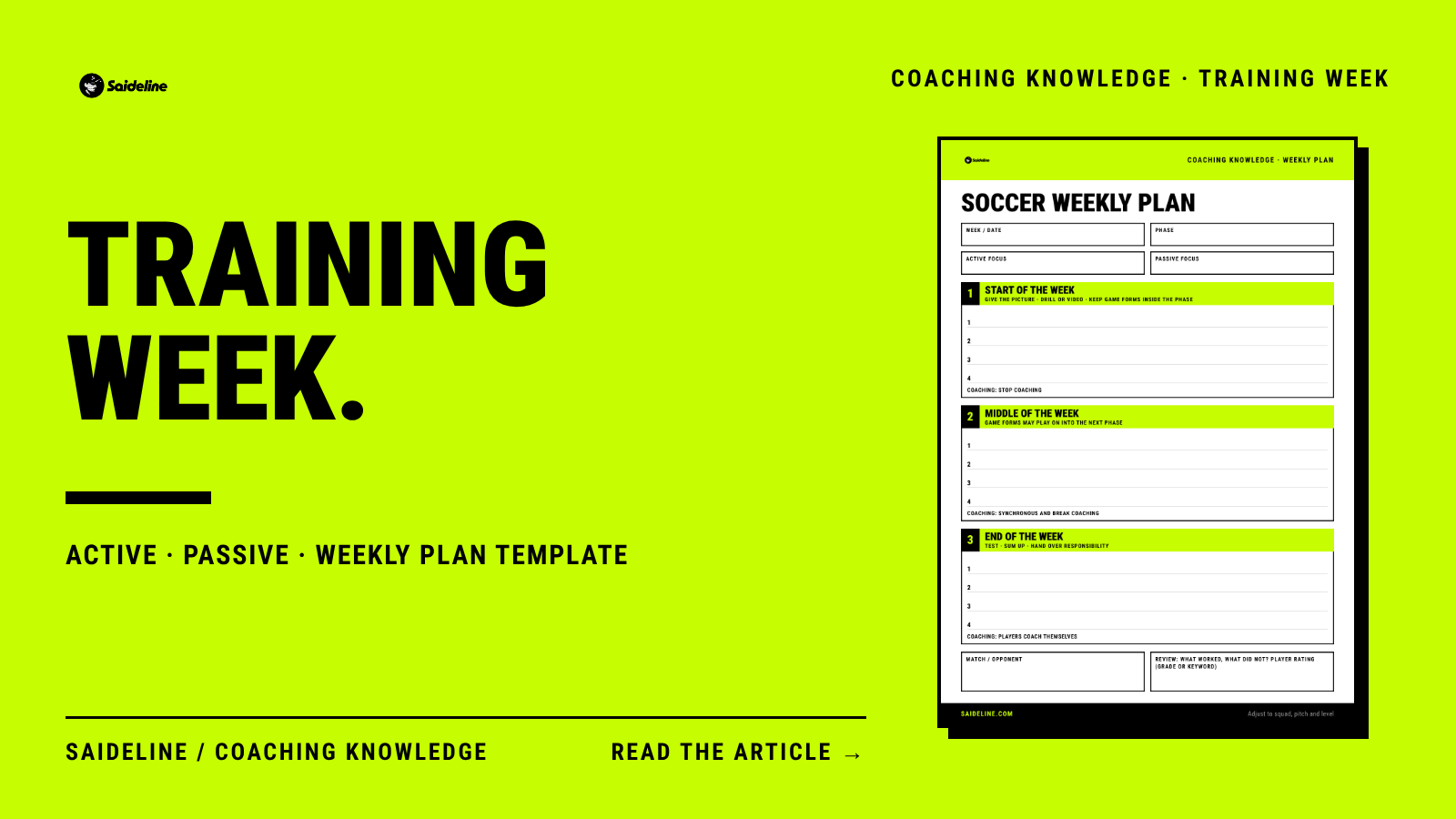
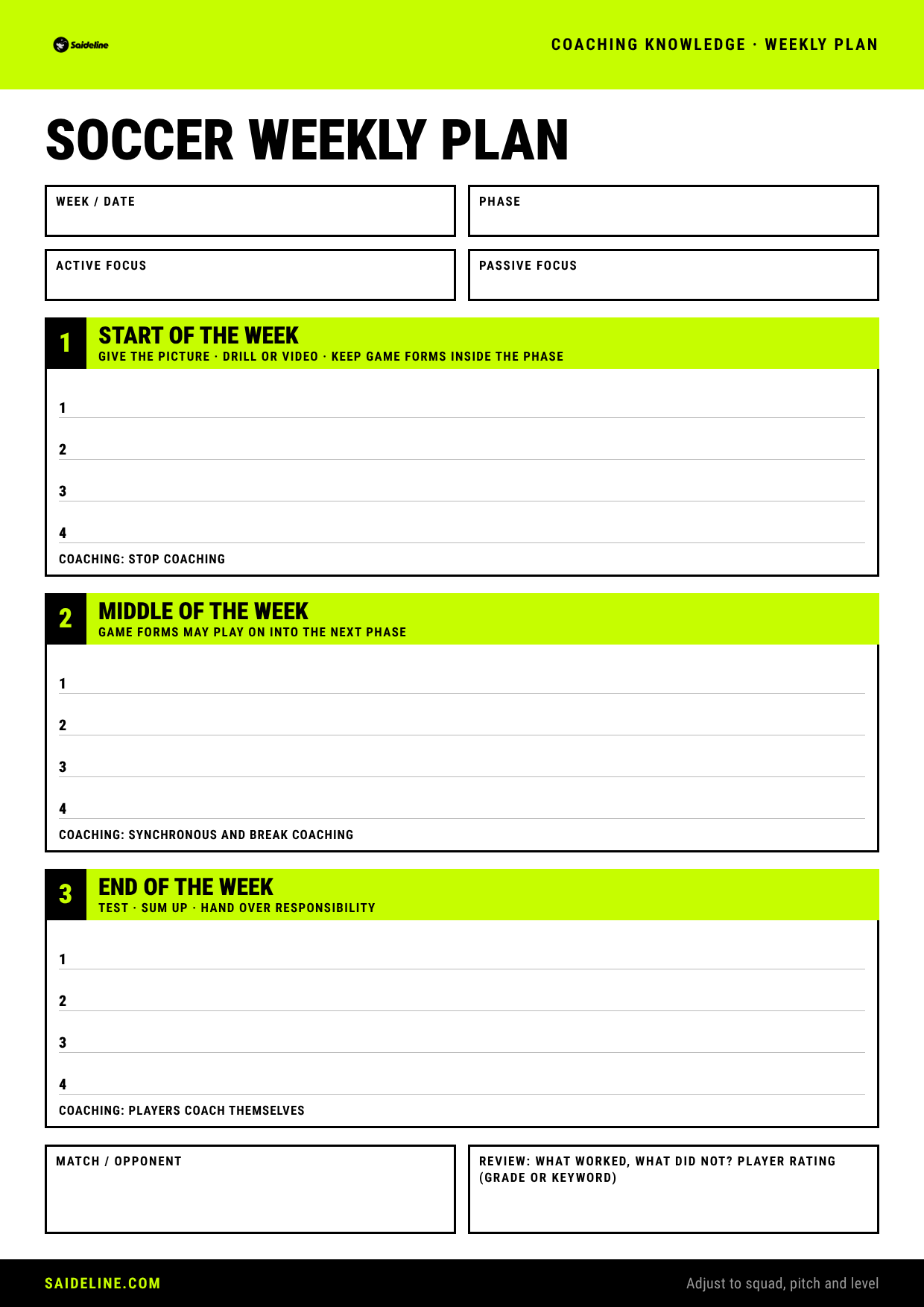
The template puts the points of the training week on one page: week and phase, active and passive focus, game forms for the start, middle and end of the week, the coaching form for each part, and space for the review. Tap or click the image and save it to your phone or computer, to print it or fill it in digitally.
Building the weekly plan in Saideline
In the Saideline calendar you set the weekly theme yourself, for example counter-press or mid block, and set the load for each session to Low, Medium or High. The load shapes the session that Saideline builds from coach-made game forms. From a calendar entry you plan the session directly, and with a link you share the week with your club: no login, no player names and no notes. The calendar is open to all users, including during the three free sessions. How it works is explained in Soccer Training Calendar: Plan Weeks, Load and Sessions, and what the free trial includes is in Soccer Coaching App Pricing: Try 3 Sessions Free.
Frequently asked questions about the soccer training week
What is a weekly focus in soccer training?
The focus is the theme you coach in every session of a week. It belongs to one of the four phases of the game, for example counter-pressing after losing the ball.
Why does the week need a passive focus?
The passive focus is the counterpart to the active one. It gives the game form an opponent that fights back: active counter-pressing goes with passively getting out of pressure.
When do I coach with stops and when not?
Stop coaching pays off at the start of the week, because the theme is new. Towards midweek you switch to coaching while play runs and in the breaks. At the end, the players ask for the coaching themselves.
What is a combat week?
A week in which everything is played to win or lose and a ranking runs alongside. You can build it around the strengths and weaknesses of the next opponent.
Conclusion
A soccer training week needs little to work: an active focus, its passive counterpart, and coaching that moves from stops to responsibility as the week goes on. The rest is organization. For next week, take the template, enter the focus and the game forms, and check at the end of the week what has arrived with your team.