
Most practice plans start with a drill someone liked. A better plan starts with a question: what should the players be able to do better at the end of this session? Everything else follows from that answer: the game forms you pick, the space you set up, how hard you make it and how the session ends.
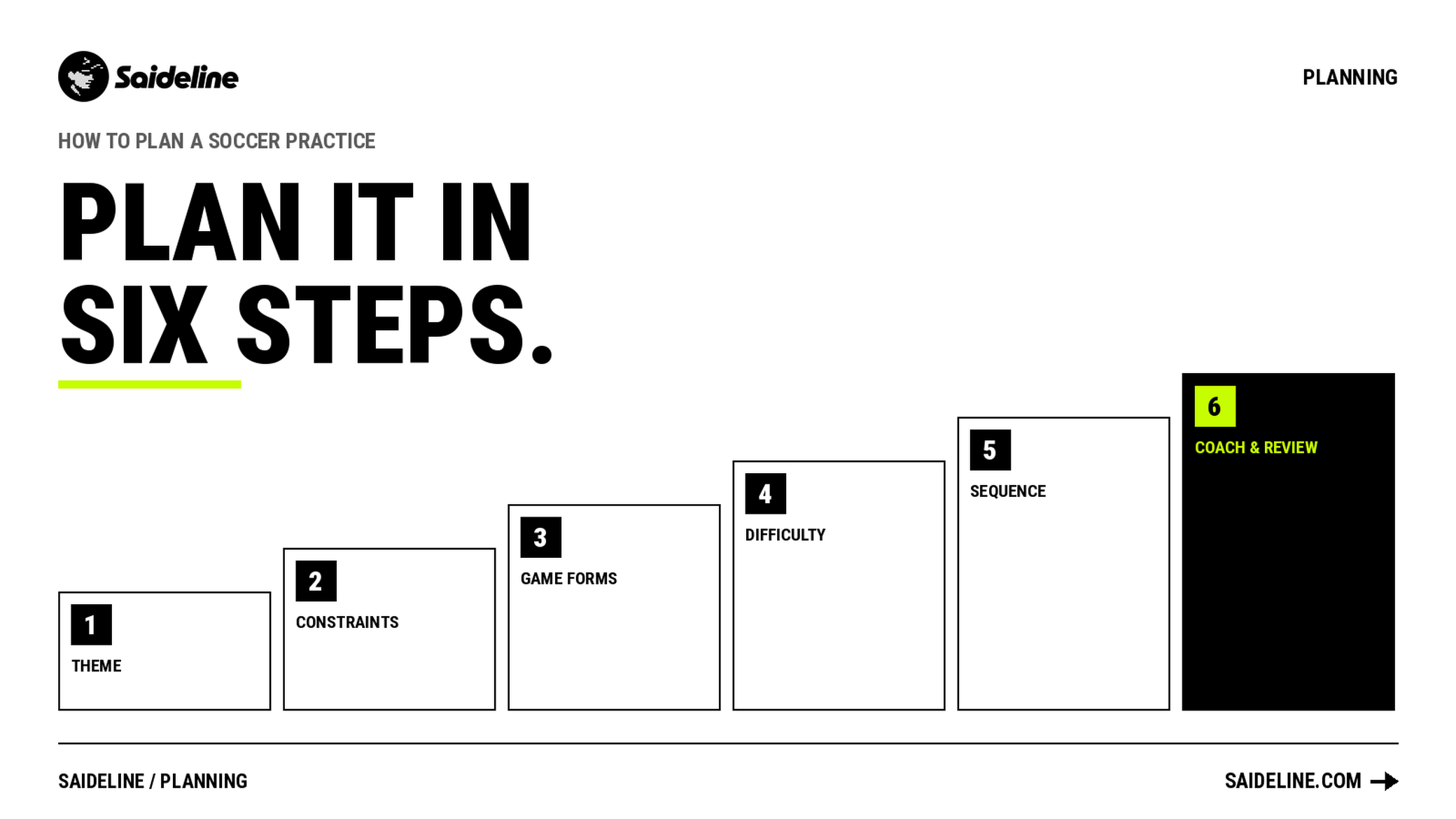
This guide walks through how to plan a soccer practice in six steps, with a sample 75-minute session at the end. It works for a youth team, an adult team or a group that changes every week.
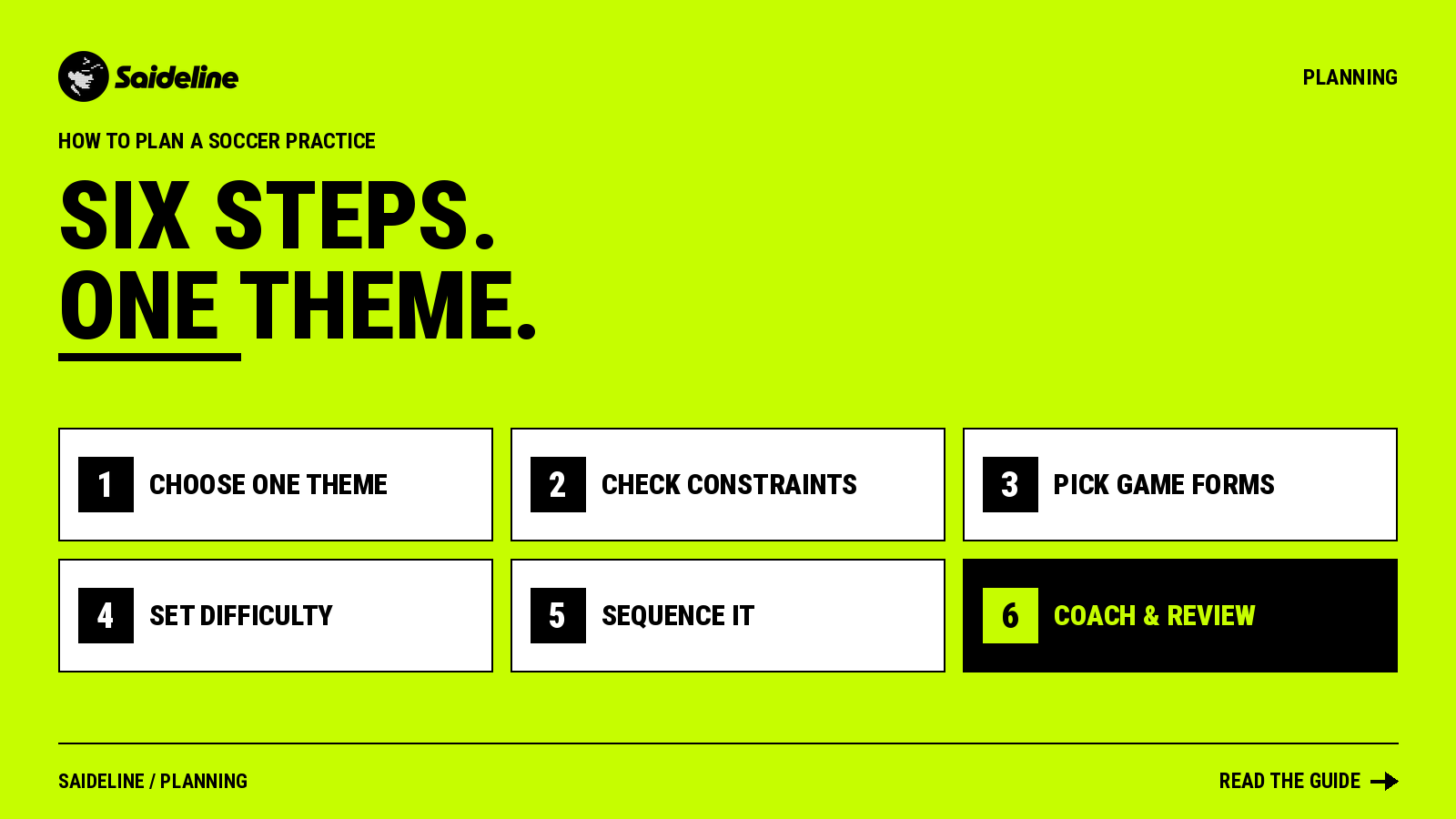
Step 1: Choose One Theme
A session that tries to fix everything fixes nothing. Pick one theme and, at most, one or two coaching principles inside it.
The easiest way to find a theme is to start from the game. Every match is made of recurring situations: having the ball against an organized opponent, losing it, defending, winning it, and set pieces. These are the phases of play. Ask which phase caused the most trouble in your last match, then narrow it down to a principle. "Possession" is a phase. "Play through reachable passing lanes" is a principle. "The central midfielder opens his hips toward the direction of play" is what a player can actually work on.
The same applies to a theme like counter-pressing: the theme is the reaction at the moment of the loss, not "pressing" in general.
Step 2: Check Your Constraints
Before you choose any game form, write down what you actually have:
- Players: how many will show up, and how many goalkeepers? Odd numbers need a plan, and so does a session with only a handful of players. Our guide to coaching with few players and the way parallel groups handle uneven squads cover both.
- Space: a full pitch, half a pitch or a few grids?
- Time: the length of the session decides how many game forms fit. Leave out the changeover time you know you'll lose.
- Age and level: the same theme looks different for a U10 team and an adult team.
The plan has to survive the evening. If five players cancel at 5 p.m., a good plan still works, because the theme stays and only the numbers change.
Step 3: Pick Game Forms That Fit the Theme
A game form is a small version of the match with rules that bring your theme up again and again. Use mostly game forms, because they combine technique, tactics, fitness and decision-making in one frame. Drills without opponents have their place for repetition of a single skill, but a decision made without an opponent is a different decision.
Check each game form against one question: does the theme come up often, and does it matter who wins? If the players can win the game without ever touching your theme, change the rules until they can't. A goal that only counts after a certain pass, a neutral player who can only play one touch, or a team that is awarded points for a regain are all simple ways to do this. Our article on drills that transfer to match day explains why this matters, and how to build soccer drills shows how to build your own.
Build the session from small to large. Start with a small-sided form for many repetitions, such as a 1v1 competition or a 2v1 into 2v2, then move toward larger numbers where the same theme appears in a more match-like picture. For ideas on small formats, see small-sided games.
Step 4: Set the Difficulty and Adjust It
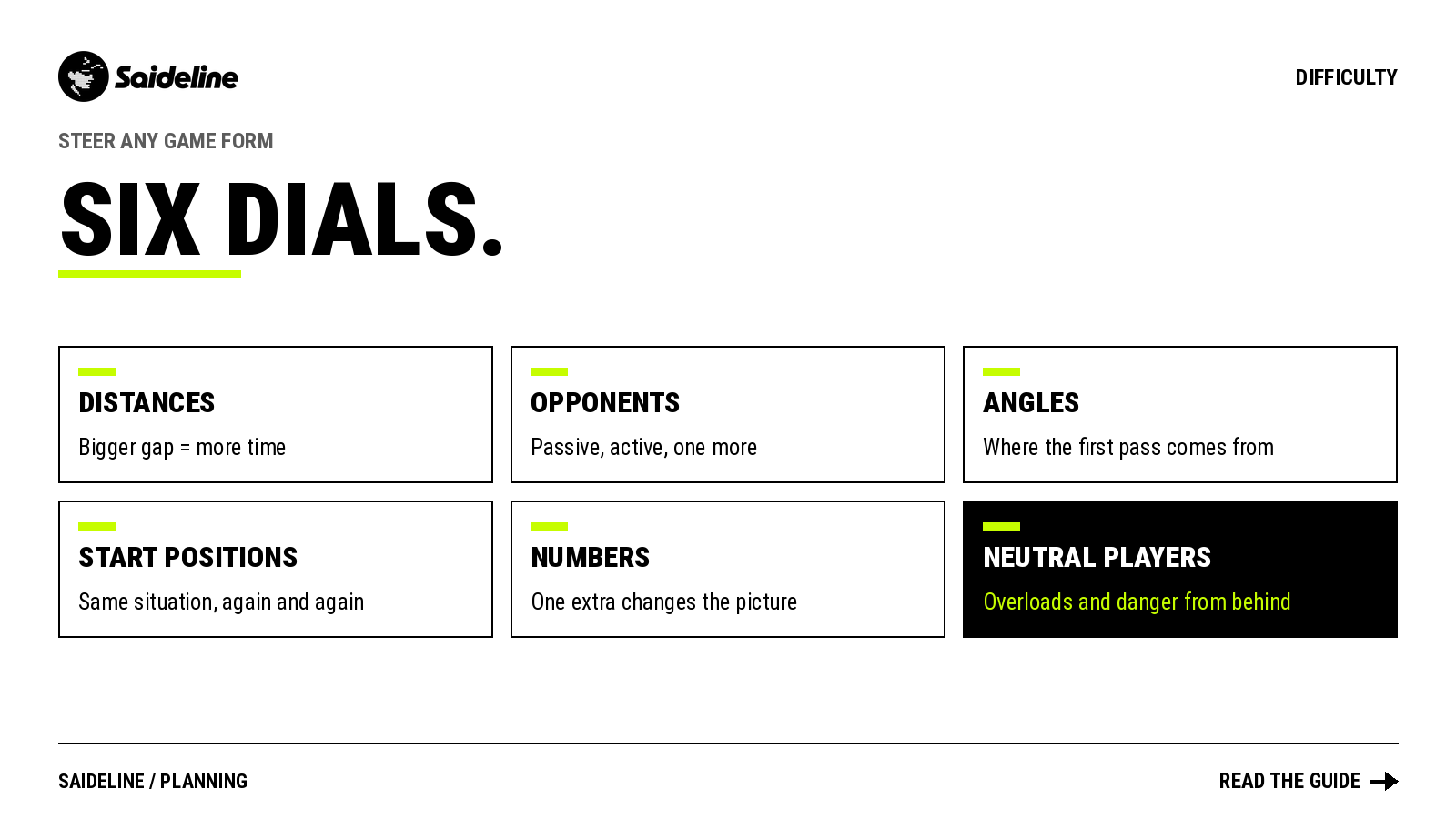
A game form is only useful if it is hard enough to challenge the players and easy enough that they can succeed. You don't need complicated tools to steer this. Six simple dials are enough:
- Distances: bigger gaps give more time, smaller gaps mean more pressure.
- Opponents: passive, active or one more than usual.
- Angles: where the first pass comes from.
- Start positions: fixed starting positions let you create the same situation again and again and change one small thing at a time.
- Numbers: an extra attacker or defender changes the picture at once.
- Neutral players: they create overloads and danger from behind.
After every change, watch. If the players master the form, make it harder. If the same problem returns, make it easier or change the focus.
When a behavior isn't happening, don't correct the symptom first. Ask why. Did the player not see the relevant cues? Then simplify the situation, for example with more distance and time. Did he see them but choose poorly? Narrow the options with target zones or mini goals. Does he choose well and lose it under pressure? Raise the intensity with closer opponents or a tighter space. Similar mistakes can have different causes, and each cause needs a different fix.
Step 5: Sequence the Session
A session needs a shape. A simple one works well:
- Warm-up: get the players moving and used to the ball, and prepare the perception they will need later. A useful rule is two players per ball. Finish with a short competition so that everyone starts the main part at full effort.
- Main part: two to four game forms on your theme, starting with more guidance and ending with less. Stop the play early on to coach, then let it run.
- Final game: end with a game that is as free as possible, even if it is only two periods of three minutes on a smaller pitch. The less you steer, the more it shows what holds up without your help.
Match your planning to the time you have. A shorter session means fewer game forms, not shorter ones.
Step 6: Coach, Observe and Carry It Over
Every game form is training and test at the same time. You create the situation, coach the behavior you want and watch how the players solve it. That tells you what is stable, where they struggle and what to expect in the match.
Keep your coaching short. A single clear sentence that links back to your theme works better than a long explanation. Rules in the form "if..., then..." are easy to remember, for example "if the defender is facing the wrong way, then play forward at once."
Then carry the theme forward. If a situation came up in training and wasn't solved, bring it back in the next session in a slightly different game form. A weekly rhythm that rotates through the phases of the game gives the plan a frame, and you can read more about it in our guide on planning around the phases of play.
A Sample 75-Minute Session
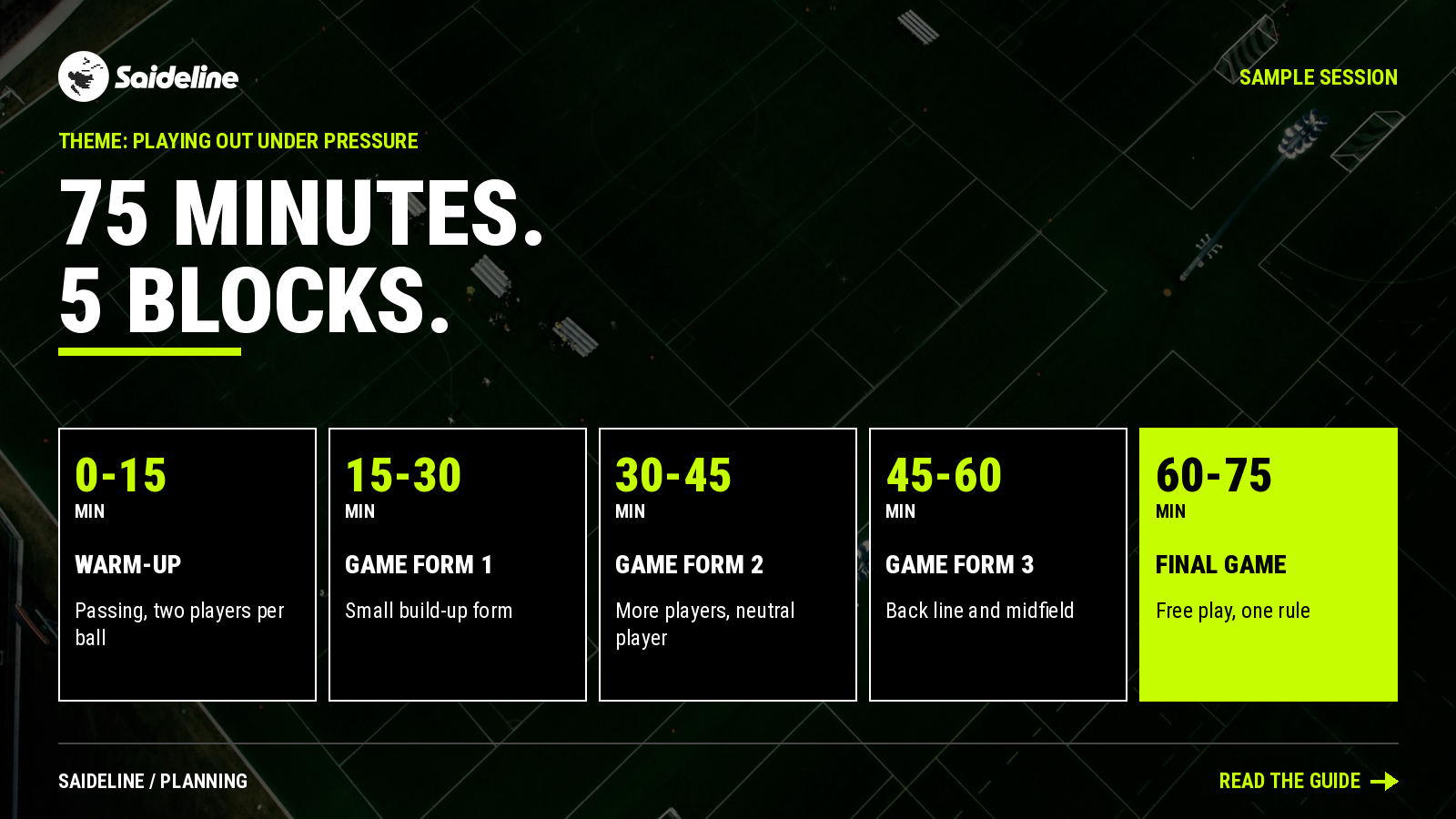
Here is an example for the theme "playing out under pressure":
- Minutes 0 to 15, warm-up: a passing warm-up with two players per ball that ends in a short competition. This 1v1 into 2v1 warm-up works well.
- Minutes 15 to 30, game form 1: a small-sided build-up form with a defender who starts facing the wrong way, as in the 2v1 into 2v2 drill.
- Minutes 30 to 45, game form 2: the same idea with more players and a neutral player.
- Minutes 45 to 60, game form 3: a larger form where the whole back line and midfield take part, with points for passes that break the first line.
- Minutes 60 to 75, final game: a free game on a full or half pitch, with only one simple rule that rewards playing out.
Common Planning Mistakes
- Too many themes in one session.
- Drills that don't match the theme, so the players practice something else.
- Long waiting lines instead of small groups with many repetitions.
- No free game at the end, so you never see what holds up.
- Too much coaching, so the players only follow instructions.
- No adjustment: the form stays the same although it is too easy or too hard.
Plan Faster With Saideline
If you would rather not build every session by hand, Saideline creates a full session from your request: you describe the phase of play, the principle, the number of players and the space. The game forms come from professional coaches, and the AI combines them. Each game form shows a match badge so you can see how close it is to your request, and the session comes as a printable two-page plan. You can try it with three free sessions and no payment details. Our pricing guide lists everything, and the overview of planning apps compares the options.
Frequently Asked Questions
How do you plan a soccer practice? Choose one theme, check your players, space and time, pick game forms that bring the theme up often, set the difficulty, order the session from guided to free play and end with a free game. Then review what worked and carry the theme into the next session.
How many game forms should a session have? It depends on the length. A 75-minute session works well with about three game forms plus a warm-up and a final game. A shorter session means fewer game forms.
How do you plan a practice with few players? Keep the theme and change the numbers. Small groups mean many repetitions, and a handful of players can still train 1v1, 2v1 or 2v2 with neutral players.
How do you plan a practice when the number of players is odd? Use a form that runs in two parallel groups, or add a neutral player so the numbers work. The theme stays the same.
How do you adjust a game form that is too easy or too hard? Change one dial at a time: distances, opponents, angles, start positions, numbers or neutral players. Then watch what happens before you change anything else.
Why end with a free game? It shows which behavior holds up when you give less guidance. Even two short periods on a smaller pitch are enough.